
Perhaps it has something to do with my own superannuated state, but it seems as though even those older than I, when they finally ride on ahead and cross the shining river, are struck down in their prime. In writing an encomium, does this bit of tongue in cheek seem lacking in gravity? It isn’t meant to, but rather my attempt to pen something I think might appeal to Mary Cosh, someone I’ve thought a lot of for very many years- and out of sight for very many years, but never out of mind- and sorry to find she’s died last December at age 100.

A near neighbor when we lived in Islington, the borough in London just to the north of the City, she became my acquittance through our mutual interest in the amenity society The Georgian Group. During my time as an employee, though my ostensible title was archivist, I was unpaid and spent my time beavering away, organizing box files of casework documents, covering, it seems, the whole built environment of England and Wales. The Georgian Group’s brief then as now was the licensed consultancy for Georgian architecture- be it terrace house or stately home, even a garden feature constructed between 1714 and 1837 was part of its remit. The group itself was only formed in 1937, so organizing these box files was not precisely cleaning the Augean stables, but it seemed a big job of work to me.
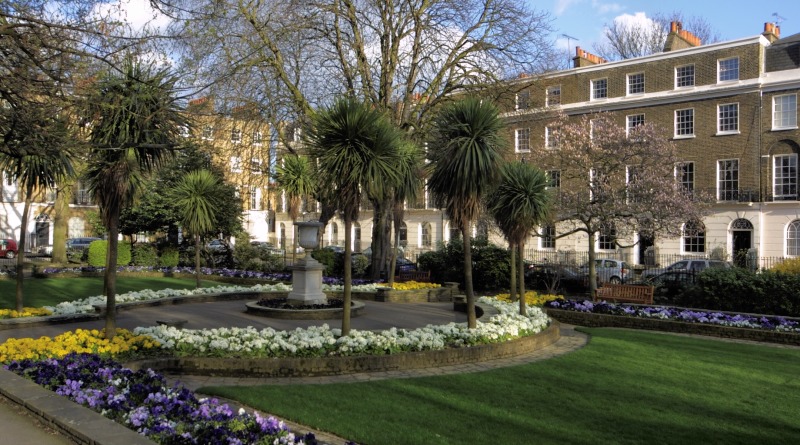
Canonbury Square, Islington, London, courtesy Canonbury Society

Seeing Mary Cosh, though, was always a delight, and I did so frequently once we found we were neighbours. Her history of our own borough of Islington was well underway when I met her, with parts of it already published in various journals. She was a caution- outspoken but always with a twinkle, very bright, but with a gaudy past. I often met Mary at the Canonbury Square flat of our mutual friend, the artist Sebastian Minton and on one occasion, I happened to mention how I had heard Bloomsbury artist Duncan Grant had maintained a studio nearby. ‘Oh he did, indeed. It was a slum then, you know. I posed for him frequently, and a couple of times with the boys he had.’ Really? ‘Oh, yes. Nude you see. It never bothered me, they were all queer and knew nothing would come of it.’
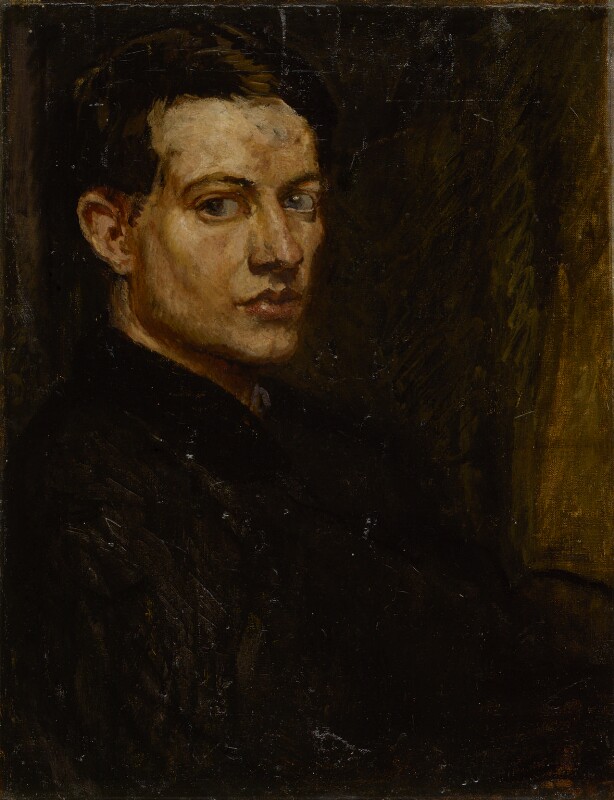
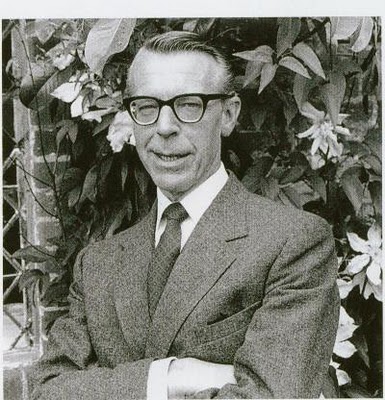
Duncan Grant, circa 1920, courtesy Nat’l Portrait Gallery

Sebastian and Mary were nearly always on members days out with The Georgian Group and beyond this were inveterate visitors to stately homes. When I knew them, Sebastian being perhaps older- though I’m not certain of this- was not terrifically steady on his pins. Mary though had a car and was yet driving and with Sebastian collected, the two of them would regularly make their way into the countryside. Sebastian was likewise possessed of an exhaustive knowledge particularly of Canonbury, and with his past with gaudy elements, too, imagine that he always had plenty to talk about with Mary.

Of course, it makes me sad to think Mary is gone from us, Sebastian, too, but I have to say, it was a privilege to know her. I plan to immediately reread Mary’s History of Islington. Though perhaps a wistful occupation in this time of sheltering in place, I’ll train my focus on how I enjoyed living in the borough, and how I enjoyed my fortunate acquaintance with Mary Cosh.
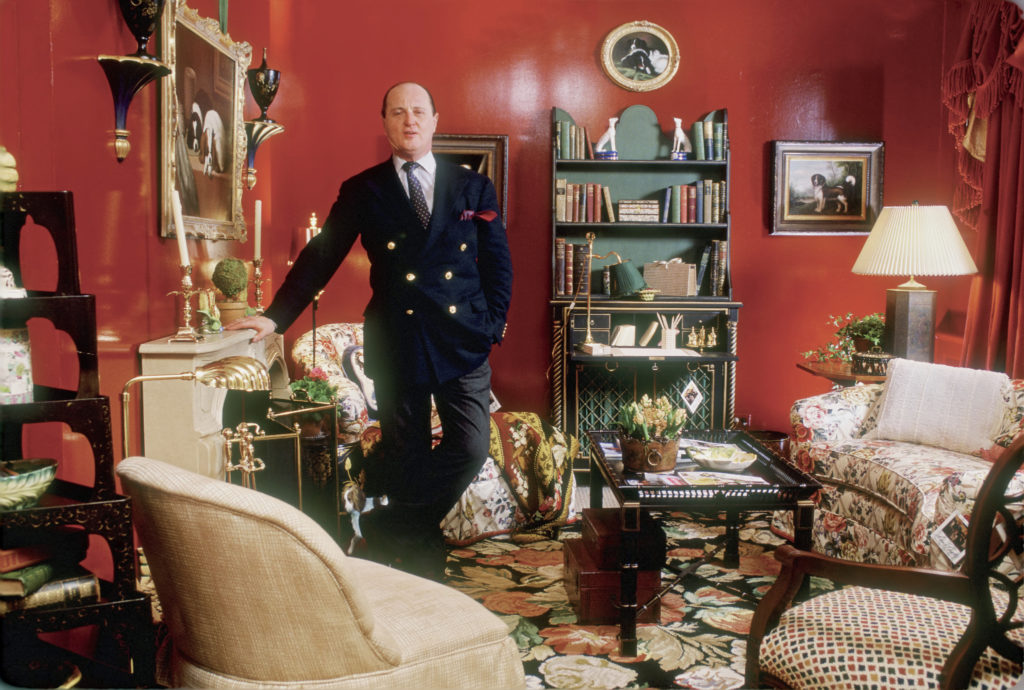
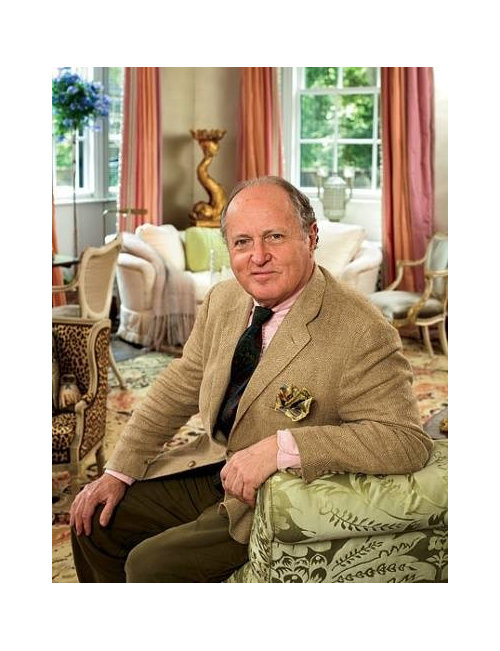
Mario Buatta, courtesy New York Times
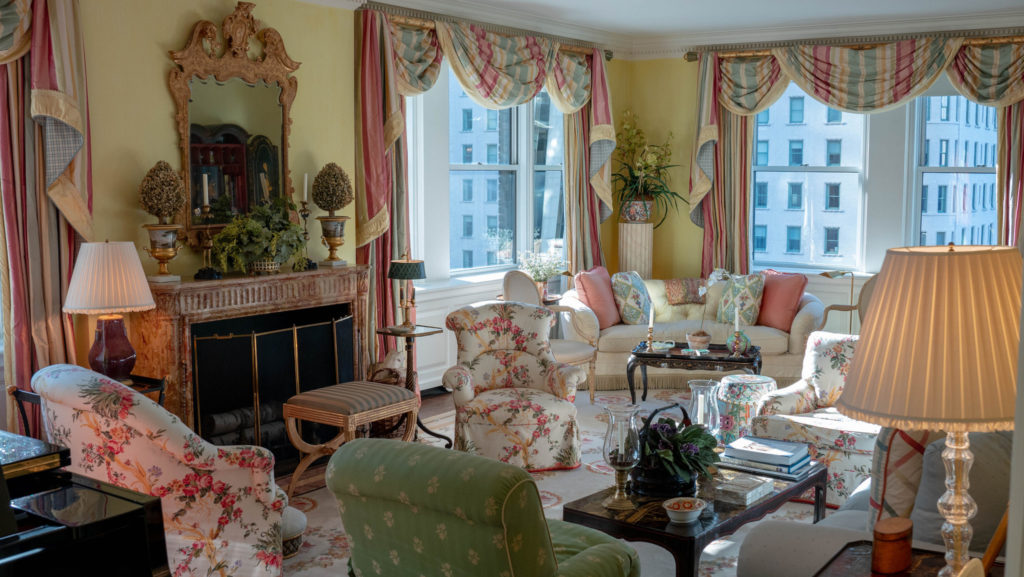
Classic Mario, courtesy New York Times

This morning, I’ve been bidding at an auction in upstate New York devoted to the decorative items possessed by the late Mario Buatta- not precisely floor sweepings, but the lesser items not sold at the more illustrious sale held a few weeks ago at Sotheby’s in New York. This may be a little too close to the coronavirus epidemic for comfortable mention, but I must say, based on the stratospheric prices commanded at both Sotheby’s and the upstate auction, it appears there is another, at least localized epidemic strayed along the Hudson causing some significant confusion of mind. Less caustic is perhaps a characterization of what’s gone on, that the late prince of chintz was held in profound esteem, witness the significant premium items in his collection have commanded. With all that, reverting now to my caustic métier, one can recall how the sale of the Regency period decorative items in the collection of the late Bill Blass were profoundly in excess of what might be considered reasonable. For those of us in the trade, items that sell well above what one considers a healthy retail price is cheering, but as with the Bill Blass sale, those items in Mario’s collection and their result have much, much more to do with a possessive desire to affiliate with the career of a man of extraordinary talent. Further on down the road, will anything with a Mario Buatta provenance boost the price if resold? Time will tell, but for those of my gentle readers who don’t already know this- save a royal provenance, who owned it before seldom adds any future value.

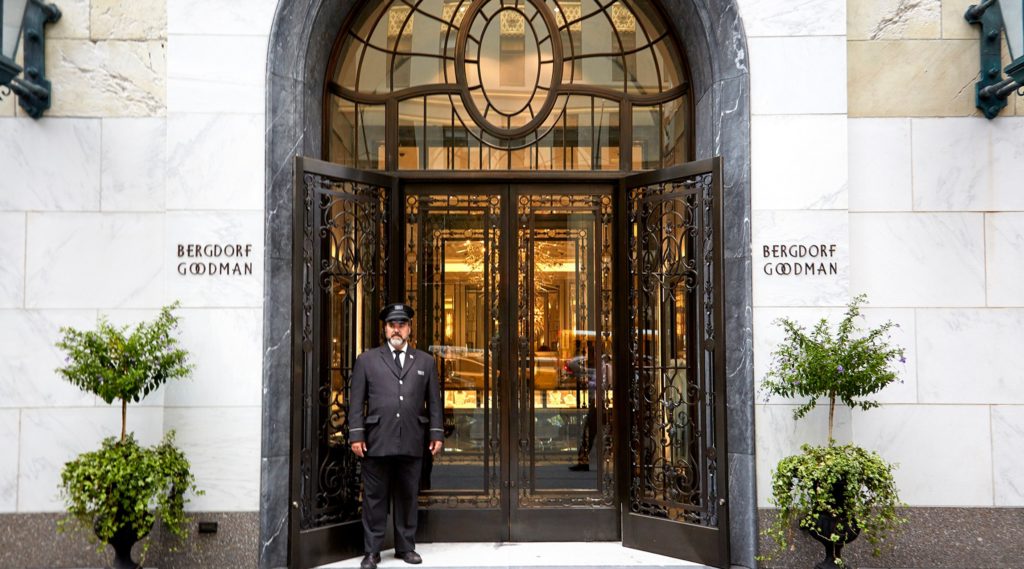
In rereading the last paragraph, my dealer cynicism overarches what really needs saying, and I must needs make it clear that Keith McCullar and I thought quite a little bit of Mario. I can’t say we were on intimate terms, but we did become acquainted with him nearly 20 years ago through involvement with an antiques fair in New York. We were still fairly new to the trade, where Mario was of course at the top of his game but was nevertheless friendly to the point of ebullience toward two fellows that he didn’t know from a load of coal. We did a modest amount of business with him at the time, but happened to see him a few days later at Bergdorf’s, or rather, as we were making a purchase he saw us, came over and told the salesman, with whom he was obviously well acquainted, what extraordinary men we were with exquisite taste. I have to say, Keith and I gushed purple with shall I say coy embarrassment, but the Bergdorf’s salesman was impressed, and for years after, we got frequent missives from this fellow- trying to sell us, of course, but we felt special nevertheless.

John Fowler, ca 1960, courtesy Colefax & Fowler

Mario considered himself a disciple of John Fowler, the originator of the English country house style whose name survives in his eponymous firm Colefax & Fowler. In fact, very many of the items offered at auction were sourced from this London firm. I would be surprised to find that John Fowler, or Sybil Colfax or Nancy Lancaster used any less printed fabric than Mario Buatta, but where Mario never took the prince of chintz moniker as anything other than something fun, I can’t imagine the sometimes/oftentimes prickly character of John Fowler would have met anything like this with the same aplomb.

For all of this, though, Mario’s skill and the regard in which he was held is rather occluded. His client list was long and illustrious- and long lived. He worked for very many clients for almost the entire length of his very long career. For little old Chappell & McCullar, I have to say that whatever we did with Mario’s office was handled with the utmost professionalism. Mario was cut from the same bolt of cloth- chintz, no doubt- as his contemporaries Albert Hadley and David Easton, and several others from whom one always dealt in business with absolute probity. Oh, that more design professionals today were as professional in their practice as was Mario. The prince of chintz, you will be missed.

Mario, courtesy New York Times

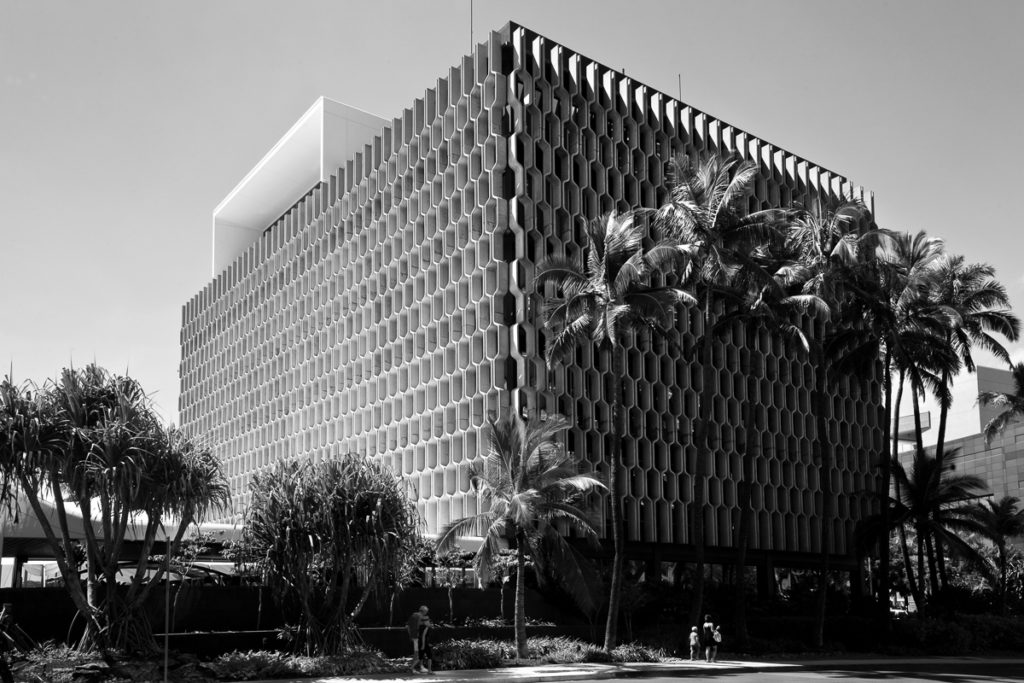
Vladimir Ossipoff, IBM Building, 1962, as built

‘Lucky you live Hawaii’ and lucky indeed, as a sometime resident of the 50th state for over 40 years- on Maui and the big island of Hawaii, but mostly on Oahu and in Honolulu proper. One of my first visual recollections of the built environment is of the IBM Building on Ala Moana Boulevard, behind which my offices were sited. It was the view of this iconic building that I saw at least twice a day, coming and going from work, that served to imprint forever the work of the likewise iconic architect Vladimir Ossipoff (1907-1998). The building itself survives, where, sadly, the verdant charms of the garden office complex where my work was located does not. Indeed, with so much of the low-rise development in this portion of Kakaako now given over in the last few years to a forest of high rises, the IBM Building is a fortunate survival. Timelessness is a cliché given out too frequently, and often for those things though extant are trapped ineluctably in their own time. The IBM Building, indeed so much of Ossipoff’s work, properly defines timelessness, as an aesthetic transcendence that, though it were designed and built some six decades ago, nevertheless appears of current moment- au courant, with a contemporary resonance and absent anachronisms that fix it irretrievably in a specific (past) time.

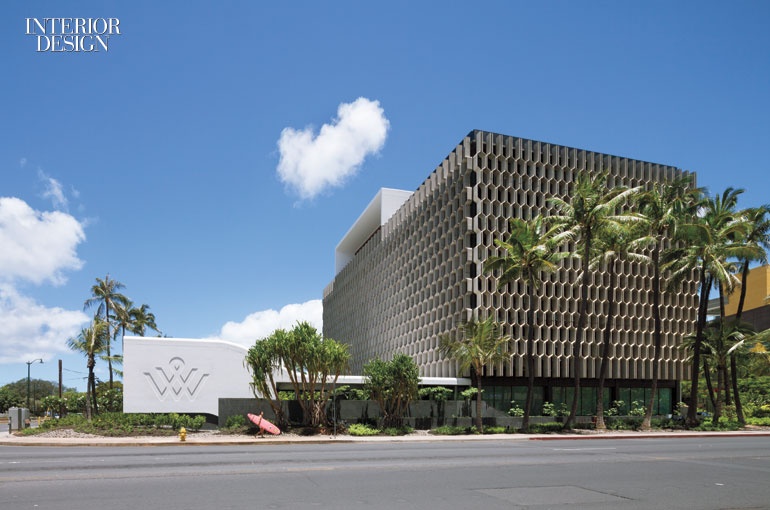
IBM Building, as now

Unfortunately, while the IBM Building on its own is wonderful in very many ways, the development that has recently grown up around it works very very hard to diminish it. Although trained in a beaux-arts tradition, Ossipoff escaped this outmoded imagist school of architecture and emerged very much an architectural realist more akin to modernists Le Corbusier and Mies Van Der Rohe, very nearly always rendering his designs in a contemporary idiom and specific to the sites where they would be built. As constructed and as it has existed for most of its life, the building is a landmark, with its distinctive screened surface able to be viewed from all four sides, and sited properly in the center of the land area it occupies, with an adequate set back to give it, shall we say, presence. Now, it is dwarfed by the buildings that surround it. It also serves as the showroom location for the developer who has wrought this unfortunate change to the local environment, who has also grafted onto the Ala Moana Boulevard front a sad and overlarge excrescence that serves as entryway and display area for the developer’s current and pending projects.

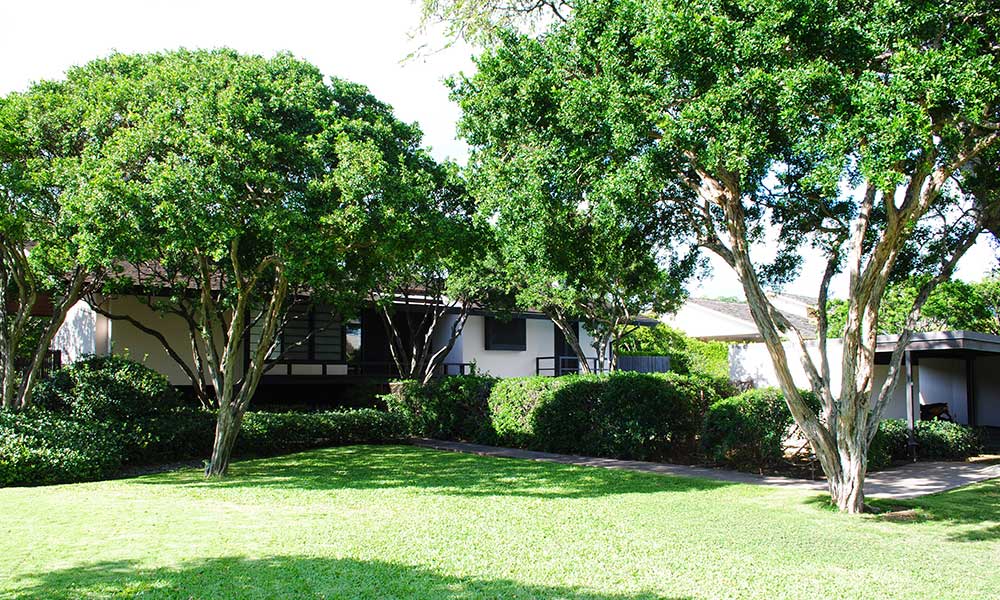
Goodsill House front elevation, courtesy Historic Hawaii Foundation

Although I’ve introduced this essay with a consideration of the IBM Building, what actually put me in mind of Ossipoff was a visit to one of his residential commissions, what’s come to be known as the Goodsill house, completed by Ossipoff in 1954. For a number of years, this extraordinary home has been owned by the Honolulu Museum of Art and served to house its director. Sadly, the museum can no longer afford to do this, and is now offering the house for sale. Would that I could afford to purchase it. While at first sight it isn’t particularly obvious that it bears any aesthetic connection with the IBM Building, it nevertheless has some similarities. Firstly and perhaps most prominently, it is properly sited on a large building lot that extends to nearly a half an acre. The gradient was basically unchanged from its original state, and the house as sited seems organic and embracing its setting. In an effort to preserve the house as built it has been given an historic designation. I have though been given to understand that some interest has been shown in the property by certain people who would strip the house of its designation, thereby giving them the opportunity to tear it down and build something larger in its place. I shudder to think that anyone could bring themselves to consider much less mouth such wantonly irresponsible spoliation.

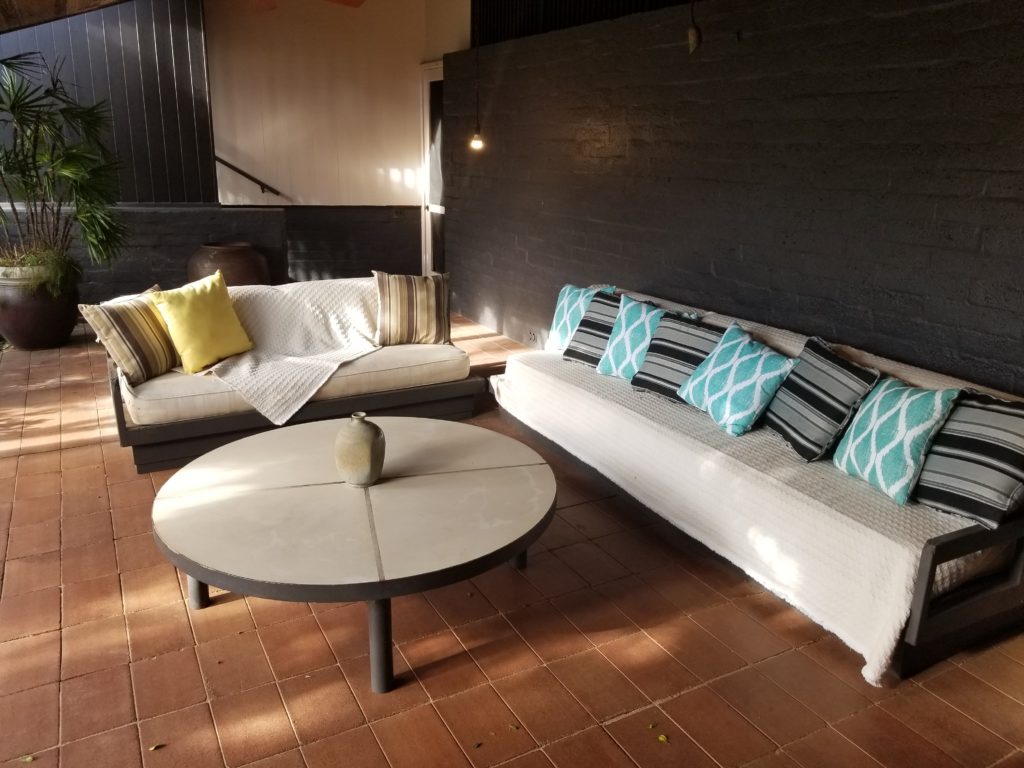
Goodsill House lanai

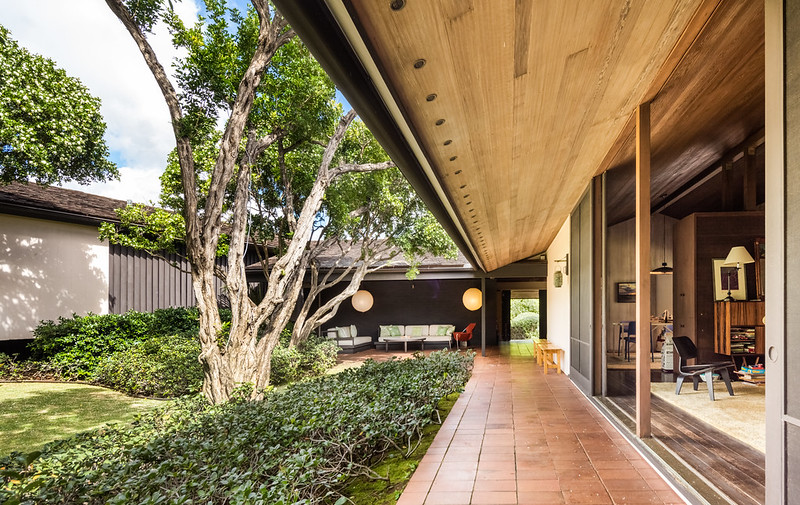
That aside, it was a joy for me to make my way around. With an open full-length vista from the living area to the back garden, the front portion of the house fully embraces the softly comfortable weather as well as the tropical beauty of what is largely a natural setting. This is then joined to an adjacent outdoor seating area, covered by a wide overhang. Angled from this is the bedroom wing, privately separated from the living area, and sited, as with the rest of the house, to take advantage of the prevailing trade winds blowing from the north east to the southwest.

Goodsill House lanai and roof overhang, courtesy Historic Hawaii Foundation

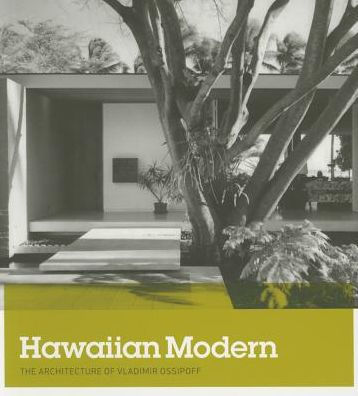
All of this- an organcism specific to its site is what immediately joins, for instance, the Goodsill house to the IBM Building. What is less apparent, but very obvious when the body of Ossipoff’s work is considered, is his contribution toward the development of a specifically Hawaiian design aesthetic. Ossipoff worked consciously throughout his 60-year career in Hawaii synthesizing an endemic Polynesian vernacular with the strong influences of the far east enjoyed by the state and introducing contemporary influences in domestic architecture expressed on the mainland by older contemporaries Richard Neutra and Rudolph Schindler. The recognition of Ossipoff’s body of work was recognized in an extraordinary exhibition hosted by the Honolulu Museum of Art in 2007 curated by Dean Sakamoto of Yale University, who masterfully prepared the essays and catalog that accompanied the exhibition.

Fortunately, very much of Ossipoff’s work survives and while it does maintain its own integrity, the state as a whole is, shall we say, in flux, and as with the area surrounding the IBM Building, is influenced strongly by changes in economic forces, oftentimes baleful in their effects. Through most of Ossipoff’s working life, the state of Hawaii with its trading center at Honolulu was largely agricultural, with the so-called Big Five planters in control of the main crops that represented the lion’s share of the state’s gross domestic product. Beginning well before his death in 1998, plantation agriculture was waning and virtually disappeared, and displaced almost entirely by tourism as the engine driving the state’s economy. Although occluded by the large numbers of tourists in the state at any given time, the permanent population has declined, with increasing numbers of people leaving, looking for work on the US mainland. However, while a waning population might be thought to produce an excess of housing stocks resulting in falling prices, inward investment from Japan in the 1980’s and early 1990’s, and from an economically robust China in the last 15 years has resulted in huge price appreciation- and the development of innumerable high rises for sale specifically to first Japanese, and more recently Chinese investors.

Despite the fact that Ossipoff was responsible for some 800 commissions during his long career, this did not involve urban planning beyond the ‘War on Ugliness’, an effort he spearheaded in the mid 1960’s to direct the aesthetics of the buildings in the then rapid high-rise resort development of Waikiki Beach. It is difficult to measure whatever success he achieved, although, for the moment, long stretches of Kalakaua Avenue, the main thoroughfare through Waikiki, maintain, if not any kind of architectural cohesion, at least an overall pleasant aspect. I don’t really intend any irony here, as much of Kalakaua through Waikiki is ‘canyonized’- the effect of a thoroughfare bounded on either side by high rise buildings, which effect Ossipoff castigated in his war on ugliness. Ever the realist, though, Ossipoff saw the increasingly intense development of Waikiki as the inevitable outcome of the state’s economic reliance on tourism. He was consulted on the development of the Royal Hawaiian Center that fronts

Kalakaua Avenue and while the shopping venue itself is of a rather severe concrete trabeated and split-faced design, it is softened by extensive landscaping and curvilinear walkways of multiple elevations along its street frontage.

Royal Hawaiian Center

We’ve a break in the action just for the moment, allowing us time to sit and watch TV. The benefit of modern TV watching is the access to 1,000’s of programs, and one of which is ‘The Art Detectives’. I must say, host and researcher Bendor Grosvenor I have a soft spot for, and not just because of his aquiline nose. A bit more personally than that, he did not so long ago on a programme featuring the series of portraits by Peter Lely known as the Windsor Beauties interview my great and good friend and old thesis supervisor at UCL Diana Dethloff, who’s special study the beauties are.

In the outing we’ve just watched, Dr Grosvenor examines a Rembrandt self portrait at a National Trust property, and after some in-depth scholarly and scientific research concludes that the portrait and its variants in Germany and the Rijksmuseum in Amsterdam are at the very least linked to the artist’s workshop, even if not definitely by his hand. In the course of his examination, Grosvenor did interview the chap in the Netherlands who is now considered the world’s leading authority on Rembrandt. When asked about considering the portraits in light of connoisseurship that begged their comparison, the expert rejected this out of hand, saying that he never applies any connoisseurship to a consideration of artwork, relying entirely on scientific analysis.

Well- there you have it. The practiced eye that can sometimes with merely a glance suss out what might otherwise be occluded, the ability to discriminate between what’s good and shall we say what’s less good we toss aside in favour of the aridity of scientific analysis. Or should I say, the flair and judgement and confidence of the art historian must needs be replaced by machines. A human examination and contextualization of what is arguably the most glorious production of human material culture is to be removed from that other glory of humanity- critical thinking.

It is I suppose one of many darkening episodes in this modern age that machines have invaded everything and their production exalted and in the case of the Rembrandt expert, it is I suppose easier to use some kind of objective calibration than to employ the little grey cells to intellectualize the meanings that might be divined from some objective measure.

Not so long ago, I enjoyed an evening out with an excellent violinist who in addition to her performing schedule regularly teaches a master class for budding musicians and musicologists. She expressed her frustration that in the main her students were unaware of critical thinking and when asked questions that required some kind of gathering of facts and the drawing of conclusions- the simplest sort of Aristotelianism- she would get brief what she termed ‘factoids’- simple conclusive bits of information gleaned from the internet that while perhaps related to whatever question she might have posed did not in themselves provide any sort of answer. She wondered whether her students, in the aggregation of factoids, hadn’t themselves thought that they might magically coalesce into some kind of coherent explanation and conclusion.

Critical thinking is the boon companion of connoisseurship, while naked empiricism should be its servant. I have to admit, in the discipline of art history over the course of the last few decades, the connoisseur has got something of a bad rap. One thinks immediately of the uber connoisseur of the last century, Bernard Berenson who early on made his reputation by using his practiced eye to systematize the work of Italian artists of the early renaissance. Of course, all that happened at a time when even photography was in its infancy, and Berenson’s work was largely accomplished the result of his personal examination of innumerable works, often times in less than optimal conditions. Sadly, his earlier contributions to the history of art were occluded by what has been seen as his too cozy relationship with the likes of dealers like Joseph Duveen. It has long been rumoured that Duveen would pay Berenson as much as 25% of the retail price of a work Duveen sought to sell, just for a letter of attribution from Berenson. As Robertson Davies put it in ‘What’s Bred in the Bone’, his novel about the art world of the early 20th century, it might have been difficult for Berenson to hear the ring of probity when considering an artwork above the ring of the cash register.

For those of my gentle readers who may consider any sort of defense of the connoisseur tempered by their having seen me on hands and knees looking underneath a piece of furniture to determine if the use of glue blocks and mortise and tenon construction argue for its being the genuine article, or have witnessed my moving a painting into a darkened room so I could examine the design layer under blacklight, I would remind them that any sort of practical, technical examination isn’t the first thing I do. The first thing is- I look at the object. It is the looking that develops the practiced eye that is the basis of connoisseurship. As I have always heard it said, Anthony Blunt always exhorted his students to look at the pictures.

Oh, my goodness- I see my two chosen exemplars, Berenson and Blunt, both of shall we say tarnished reputation perhaps argue less than what I had hoped in favor of connoisseurship. Well, for the time being, I happily look to Bendor Grosvenor who will I hope on TV and otherwise carry on looking at paintings in the same manner as he has, and will across his aquiline nose continue to cast a connoisseurial eye.


courtesy Antiques Trade Gazette

One of several crises in the trade the last few weeks is the huge increase in fees now charged by 1st dibs, one of the major online platforms for art and antiques. In response to the complaints of the dealers who maintain a virtual storefront on this platform, Antiques Trade Gazette reports 1st dibs claims the move is necessary to maintain its advertising, fraud protection, website optimization, and social media presence. All this to court, as mentioned obliquely by 1st dibs in its communication to dealers, ‘the sophisticated online customer.’

Well, maybe. But the more likely explanation is the simpler one- a naked move to quickly increase revenue for the owners of the platform. I had some time ago formed the opinion, or should I say joined the chorus of opinion, that this same platform sought to be the overarching presence in the trade, doing its level best to become a clearing house for all manner of luxury goods by occluding as best it could the dealers whose virtual storefronts provide the subscription revenue that provides the lion’s share of the site’s income. In so doing, prospective buyers, who might prefer to trade directly with the dealer, are then forced to deal directly with the platform when making a purchase. The platform itself can then charge the dealer a commission on the sale, on top of the monthly subscription fee charged the dealer for its online storefront. Frankly, we did at one time have a storefront on this platform, but when it became obvious they sought to make every effort to come between us and the buyer, we left. For Chappell & McCullar, indeed for nearly every dealer in the accredited trade, the art and antiques business remains a relationship one- even with so much of our trade now through our own website, the Chappell & McCullar ‘look’ is like that of no one else. The same can be said for any other dealer- as has become my mantra, it is the dealer’s taste, expertise and reputation that the buyer is purchasing, not just its stock in trade.

And of course, that is what 1st dibs sought to extinguish- substituting its own self as less the keeper than an aggregator of relationships while making the dealers who’ve maintained virtual storefronts almost entirely anonymous. In all honesty, had we been selling well on the platform, we’d probably, venal folk that we are, continued to subscribe. But we didn’t, and found ourselves paying more and more in fees, and the only occasional sale when it happened was for lower priced material that barely covered the cost of listing the item. And, and a very important and, whatever sales we had were of the one-off, spot sale variety- buyers with whom we never established any sort of relationship and beyond the single sale, never saw again.

Any business is entitled to make money and the bigger and more predominant it is within its industry, the more predacious its practices might seem. But 1st dibs has long sought to marshal the selling of items, taking advantage of a trade made up of innumerable small players who in their fearful desire to stay in business felt they had no choice but to add a virtual storefront to their bag of tricks. Traditional sales outlets of the bricks and mortar variety and the occasional fairs have not been enough for years. Indeed, the online platform has generally subsumed the traditional venues. Fairs, for decades the traditional buying opportunity in locations around the world exist in dwindling numbers, and bricks and mortar venues find themselves bereft of dealers, particularly those of period material. Indeed, our old Jackson Square neighborhood in San Francisco, once the home of nearly 30 dealers within a couple of blocks of one another, now has nary a one. At one time, 1st dibs itself was a sponsor of very many of the major fairs, particularly in the US. That, though, hasn’t happened for some years. It must consider fair advertising and promotion unnecessary, as it has itself become the country’s major, albeit virtual, fair.

Now, though, all manner of platforms have become ubiquitous. We get invites to list on a different one several times a week- tempting to take a flyer, as the introductory listing fees are always quite low. And indeed, most of the trade associations maintain platforms- not for free, but at least a dealer feels as a member of the association one is, to an extent, paying a listing or subscription fee at least partly to oneself. Even some of the online auction websites are offering dealers virtual storefronts, and as I mention it, adding online auctions into the mix, there now exists a bewildering plethora of platforms on which a prospective buyer may make purchases.

But here’s the problem for 1st dibs- the diffusion of online platforms has become so great, and the comparative ease of establishing a platform and the cost to do so so low, platforms themselves once online are hard at it to make money. And this phenomenon does not even begin to address the attrition of dealers, witness their thinness on the ground in traditional venues, that also functions to shrink platforms’ subscription fees. 1st dibs far more than any other platform is investor heavy- investors include Christie’s parent company Group Artemis- with round after round of capitalization in order to finance the building of a business that sought to dominate the industry. But clearly, as investors do, they want a payoff. That payoff is apparently to be backbreakingly borne by their remaining cadre of subscriber dealers. Where formerly 1st dibs would introduce new fees, seek to occlude dealers in order to increase its direct commission on sales, and, a traditional tactic, increase subscription and listing fees for storefronts once a dealer’s introductory rate had expired, it now feels compelled in one fell swoop to hugely raise subscriptions across the board.