
courtesy Antiques Trade Gazette

One of several crises in the trade the last few weeks is the huge increase in fees now charged by 1st dibs, one of the major online platforms for art and antiques. In response to the complaints of the dealers who maintain a virtual storefront on this platform, Antiques Trade Gazette reports 1st dibs claims the move is necessary to maintain its advertising, fraud protection, website optimization, and social media presence. All this to court, as mentioned obliquely by 1st dibs in its communication to dealers, ‘the sophisticated online customer.’

Well, maybe. But the more likely explanation is the simpler one- a naked move to quickly increase revenue for the owners of the platform. I had some time ago formed the opinion, or should I say joined the chorus of opinion, that this same platform sought to be the overarching presence in the trade, doing its level best to become a clearing house for all manner of luxury goods by occluding as best it could the dealers whose virtual storefronts provide the subscription revenue that provides the lion’s share of the site’s income. In so doing, prospective buyers, who might prefer to trade directly with the dealer, are then forced to deal directly with the platform when making a purchase. The platform itself can then charge the dealer a commission on the sale, on top of the monthly subscription fee charged the dealer for its online storefront. Frankly, we did at one time have a storefront on this platform, but when it became obvious they sought to make every effort to come between us and the buyer, we left. For Chappell & McCullar, indeed for nearly every dealer in the accredited trade, the art and antiques business remains a relationship one- even with so much of our trade now through our own website, the Chappell & McCullar ‘look’ is like that of no one else. The same can be said for any other dealer- as has become my mantra, it is the dealer’s taste, expertise and reputation that the buyer is purchasing, not just its stock in trade.

And of course, that is what 1st dibs sought to extinguish- substituting its own self as less the keeper than an aggregator of relationships while making the dealers who’ve maintained virtual storefronts almost entirely anonymous. In all honesty, had we been selling well on the platform, we’d probably, venal folk that we are, continued to subscribe. But we didn’t, and found ourselves paying more and more in fees, and the only occasional sale when it happened was for lower priced material that barely covered the cost of listing the item. And, and a very important and, whatever sales we had were of the one-off, spot sale variety- buyers with whom we never established any sort of relationship and beyond the single sale, never saw again.

Any business is entitled to make money and the bigger and more predominant it is within its industry, the more predacious its practices might seem. But 1st dibs has long sought to marshal the selling of items, taking advantage of a trade made up of innumerable small players who in their fearful desire to stay in business felt they had no choice but to add a virtual storefront to their bag of tricks. Traditional sales outlets of the bricks and mortar variety and the occasional fairs have not been enough for years. Indeed, the online platform has generally subsumed the traditional venues. Fairs, for decades the traditional buying opportunity in locations around the world exist in dwindling numbers, and bricks and mortar venues find themselves bereft of dealers, particularly those of period material. Indeed, our old Jackson Square neighborhood in San Francisco, once the home of nearly 30 dealers within a couple of blocks of one another, now has nary a one. At one time, 1st dibs itself was a sponsor of very many of the major fairs, particularly in the US. That, though, hasn’t happened for some years. It must consider fair advertising and promotion unnecessary, as it has itself become the country’s major, albeit virtual, fair.

Now, though, all manner of platforms have become ubiquitous. We get invites to list on a different one several times a week- tempting to take a flyer, as the introductory listing fees are always quite low. And indeed, most of the trade associations maintain platforms- not for free, but at least a dealer feels as a member of the association one is, to an extent, paying a listing or subscription fee at least partly to oneself. Even some of the online auction websites are offering dealers virtual storefronts, and as I mention it, adding online auctions into the mix, there now exists a bewildering plethora of platforms on which a prospective buyer may make purchases.

But here’s the problem for 1st dibs- the diffusion of online platforms has become so great, and the comparative ease of establishing a platform and the cost to do so so low, platforms themselves once online are hard at it to make money. And this phenomenon does not even begin to address the attrition of dealers, witness their thinness on the ground in traditional venues, that also functions to shrink platforms’ subscription fees. 1st dibs far more than any other platform is investor heavy- investors include Christie’s parent company Group Artemis- with round after round of capitalization in order to finance the building of a business that sought to dominate the industry. But clearly, as investors do, they want a payoff. That payoff is apparently to be backbreakingly borne by their remaining cadre of subscriber dealers. Where formerly 1st dibs would introduce new fees, seek to occlude dealers in order to increase its direct commission on sales, and, a traditional tactic, increase subscription and listing fees for storefronts once a dealer’s introductory rate had expired, it now feels compelled in one fell swoop to hugely raise subscriptions across the board.
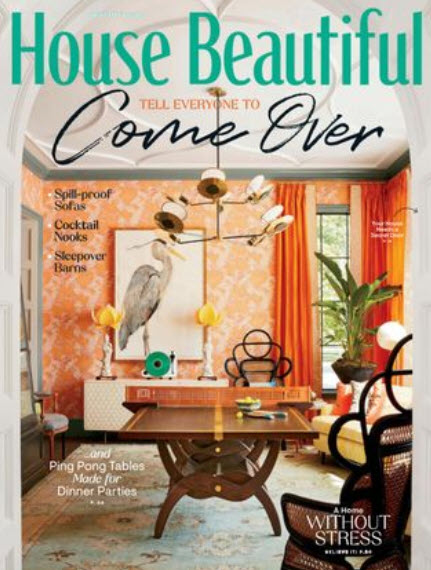
One of my gentle readers forwarded something he’d read in the online edition of House Beautiful entitled ‘Please Stop Saying Millennials Killed Antiques’ penned by a millennial, one Hadley Keller. Just reading the title, all I can say is good on her. She touches on themes about which I’ve railed for years, one of which is that the use- or should I say ‘reuse’- of period furniture is about as green as anything a body can do, and a way, as I think about it, to ameliorate one’s carbon footprint when one receives so much of one’s basic necessities delivered to the door in a fibreboard box, its materials wrenched from a denuded forest and that will shortly find its way to an overburdened, methane emitting landfill.

Miss Keller also hints at how one can achieve an updating of period furnishings by the use of a contemporary fabric, implying that antiques as found have a fustiness that millennials might find not precisely distasteful, but yet not, pardon me for saying this, cool. I have to say, I have never in my life thought about anything as ‘cool’, nor ever yet described anything as such. You’re read it here first. Still, the trade in traditional art and antiques hasn’t typically done itself any favors by massing brown furniture in dark shops that seem some kind of throwback to an age of high Victoriana. I recall what one old time dealer had told me, of how happy he was to look across his shop floor, and saw all this shiny wood, and all of it brown.

With all that, for those of us in the trade, we do all of us maintain certain specialisms. We have to, frankly, as so much of our clientele comes to us shopping for items in which they know we are expert. If we maintain a disparate array of types of gear and of different periods we limit our ability to reach both collectors and designers. It must be borne in mind that, as dealers, what we sell is an adjunct to the inspiration of our clients and not always its source. For myself, what I offer is primarily 18th century English furniture, to which, I say modestly, I attempt to bring a certain degree of connoisseurship that the client can then deploy in an interior space that appeals to their own aesthetic.

As I’ve written this, I realize that we’ve often consulted about that aesthetic and have from time to time moderated the views of particularly our millennial visitors. That is to say, we try to tell our shoppers that while we are a repository of traditional material, the notion that any interior should be replete with period material is specious. ‘Period style’ often has less to do with historic precedent than the imaginings of influential designers like John Fowler, Sister Parrish, and Mario Buatta.

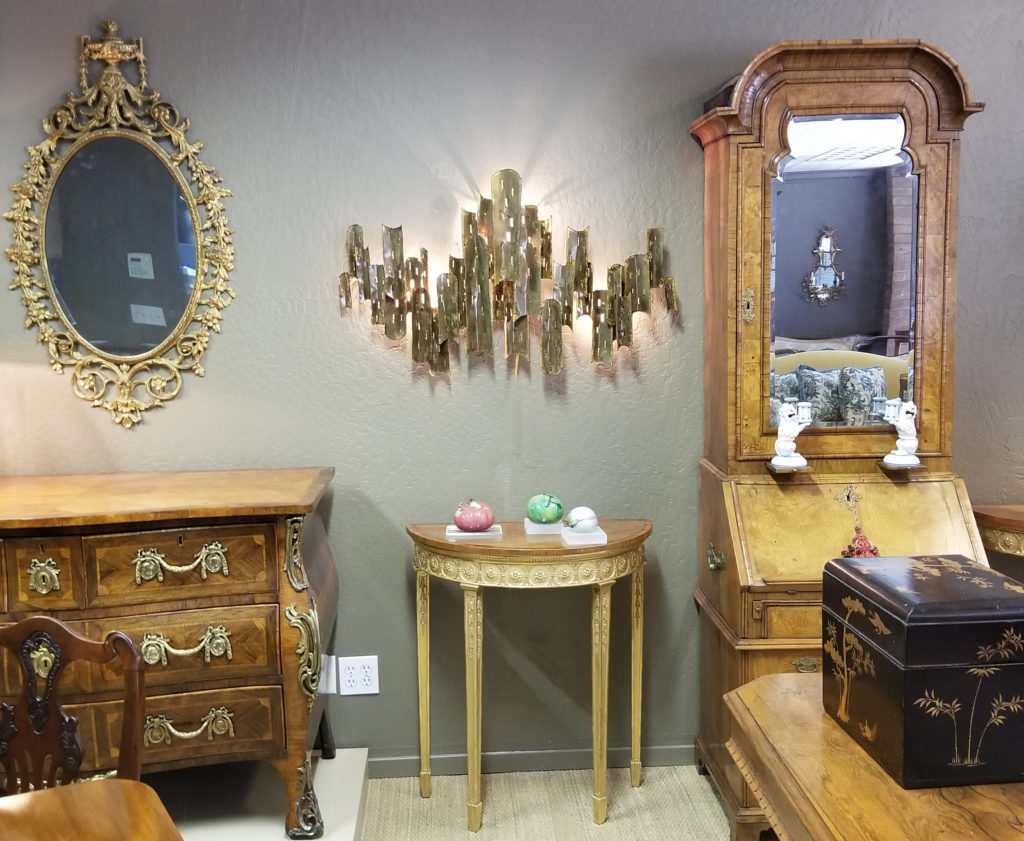
Modernist copper wall light, congenially mixed with antiques

But as I’ve read Miss Keller’s article, what’s apparent is she has something very definitely in common with the likes of Mario Buatta, even if she and her running buddies perhaps do not share his aesthetic. They are all of them New Yorkers and one would be yet spot on to say that New York is a style center, and part of that perennial triangle of art and design that includes London and Paris. And while it might be considered a hothouse, or as modern tech parlance has it an incubator, for the localized development, invention, and deployment of taste and trends, one might hope that, more broadly, Hadley’s on to something. Although she cites those who say that they buy online as live auctions and dealer premises are intimidating, I’d say that that would constitute a toe in the water, precedent, one hopes, to taking the collecting plunge


The art and financial worlds coincided this week with the news that Patrick Drahi, the new owner of Sotheby’s, has brought in art world ingenue Charles Stewart as CEO. Stewart replaces Tad Smith who after just a few years on the job was himself still considered an ingenue. It is not surprising that Drahi would bring in his own management team, with Stewart for the preceding few years the CEO of a media company also owned by Drahi. According to a news release issued by Sotheby’s, Tad Smith will stay on as ‘senior adviser’ to Charles Stewart.

In her New York Times article, Robin Pogrebin cites an analysis of Sotheby’s sale and management changes by Marc Porter, chairman of Christie’s America. Per Porter, given the $3.7 billion Drahi paid for Sotheby’s and the placement of a telecommunications executive as its new CEO, Drahi must be positioning management strategically in an attempt to achieve a return on investment more commensurate with a tech company (read ‘higher than’) what would be expected from a fine art auction house. Well, yes, but as the company is now privately held, one can only assume.

Drahi himself is a collector and at the time the sale of Sotheby’s was announced, there was some expression of opinion that in some oblique way, ownership of Sotheby’s would enhance his collecting activities. A number of years ago, something similar was said when Bernie Osher, a wealthy collector of American paintings, purchased old line San Francisco auction house Butterfield’s. That didn’t prevent Osher from selling at a premium a few years later to eBay. I think there’s very little doubt that Drahi with his appointment of Charles Stewart expects a significant amount of value added to his Sotheby’s purchase. What changes and how profitability and the inherent value of the company is enhanced are at this point a matter of speculation. Suffice to say, given the premium price paid by Drahi, Stewart has his work cut out for him.

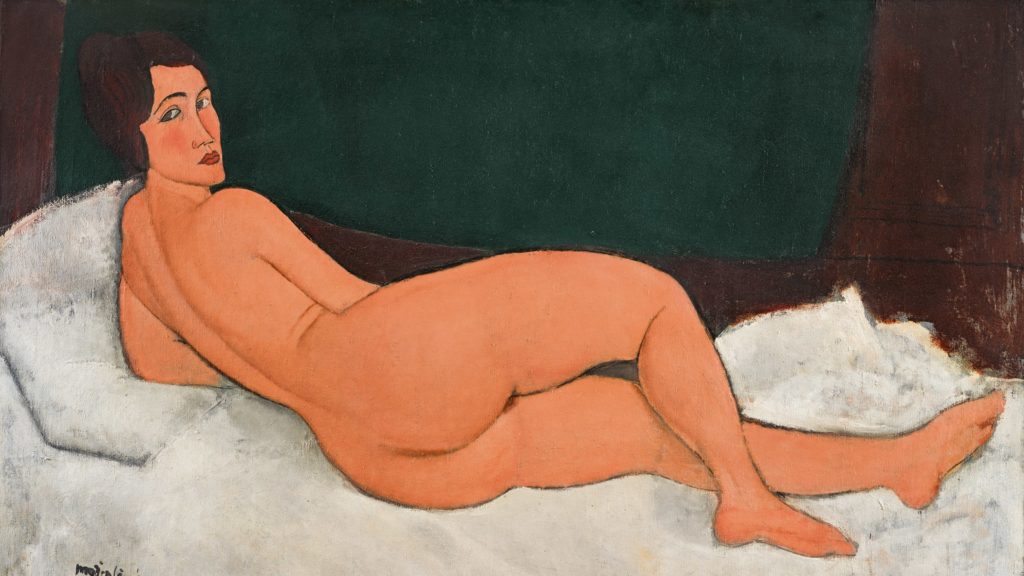
Modigliani Nu couche

And that work must be herculean. When Drahi offered $57 per share on June 17, Sotheby’s share closing price the day before was $35.39. Drahi’s offer of a 61% premium becomes mystifying when one considers the company’s dramatic swings in income and revenue. Indeed, along with Christie’s, it has for years been dependent on the next big auction sale. And along with Christie’s, has offered enormous blandishments to prospective consigners including inordinately optimistic presale estimates, cut rate buyer’s premiums, and huge advances against the sale of consigned lots. At the time of Drahi’s offer, Sotheby’s had just posted a loss for the preceding quarter and an overall decline in revenue compared to the same period the preceding year. According to The Art Newspaper, a significant portion of the loss was thought to be related to the failure of two consigned lots- Modigliani’s Nu couche and Picasso’s Buste de femme– to cover the amount of the minimum consignor payout guaranteed by Sotheby’s.

Picasso Buste du femme

Sotheby’s under Tad Smith has cast about for sources of revenue, presumably to even out the peaks and valleys of its financial performance. Along with Christie’s, it increased its number of online only sales, and it also launched an online retail platform for the sale of vintage merchandise. And, along with Christie’s, and Bonhams, too, shed a number of departmental positions within the auction house.

With all that, Sotheby’s core auction house business is under tremendous competitive pressure, and not just from traditional rival Christie’s. Bonhams, itself purchased by a private equity firm earlier in the year, has ramped up its online and marketing presence, and worldwide, every little hamlet and crossroads that was home to a local auction house now has a worldwide reach. To name one of a number, Jersey-based technology company Webreality does a burgeoning business solely to design and support the online presence of fine arts auctioneers. As well, a number of auction platforms, including The Saleroom, Invaluable, and LiveAuctioneers provide a global presence for even the smallest auction houses. While Christie’s and Sotheby’s and smaller rival Bonhams have long offered sales through their own online platforms, now Bonhams feels the need to broaden its reach, just announcing it will offer sales through The Saleroom. Given the stampede toward online sales, paradoxically Sotheby’s spent a reported $55 million earlier this year to enhance the physical plant of its New York saleroom.

Everything about Sotheby’s financially checkered recent past does now beg innumerable questions about its prospects for the future, to say nothing about the why of its acquisition. But, as the press release issued at the time of Drahi’s offer in June makes clear, taking the company private provides greater opportunity for flexibility and change, without public disclosure to shareholders. So, privately held as it now is, I suppose we’ll only have to wait and see.


I’ve got to say, watching the movie ‘Downton Abbey’ was akin to seeing at long last an old friend from whom one has been reluctantly parted and too long separated. Happy to see, and happy to see them rather unchanged. ‘Rather’ I say, as the movie itself was not quite so compelling as the episodic series which even in the course of one hour and the occasional two was not shy of incident. The movie though bringing back all the familiar characters was a little overlong given the (lack of) incident involved, and without spoiling it for you of my gentle readers who haven’t seen the movie, the subplots and asides seemed almost as throw-ins- a love interest, and some socio-political commentary, both of which, though germane, were not really essential to a fairly lightweight main plot. Two crypto-spoiler alerts- there are actually two love interests, one straight and one gay, and the movie itself is a set-up for a sequel. And why not?

Mary, the princess royal

But with all that, the movie has been well-received, though not universally well reviewed, and as often occurred during the run of the TV series, has for us engendered a begging of questions we have fielded from many quarters if the lush settings in a number of English country houses has thereby spawned an increased interest in period art and antiques.

Kate Phillips, portraying the princess royal

The short answer is a resounding- well, maybe. I have to say, this year rumblings have emerged that perhaps there is a greater interest in what is our main stock in trade, and we’ve also noted an increase in the amount of editorial in the shelter publications given over to warmer interiors with period material much more in evidence, and markedly fewer pages featuring contemporary design of the stark and spare variety. Is this the marking of a ground swelling of a change in aesthetic? Or is it, well, not life imitating art, but the shelters imitating ‘Downton…’ the movie- art, as it were, imitating art.

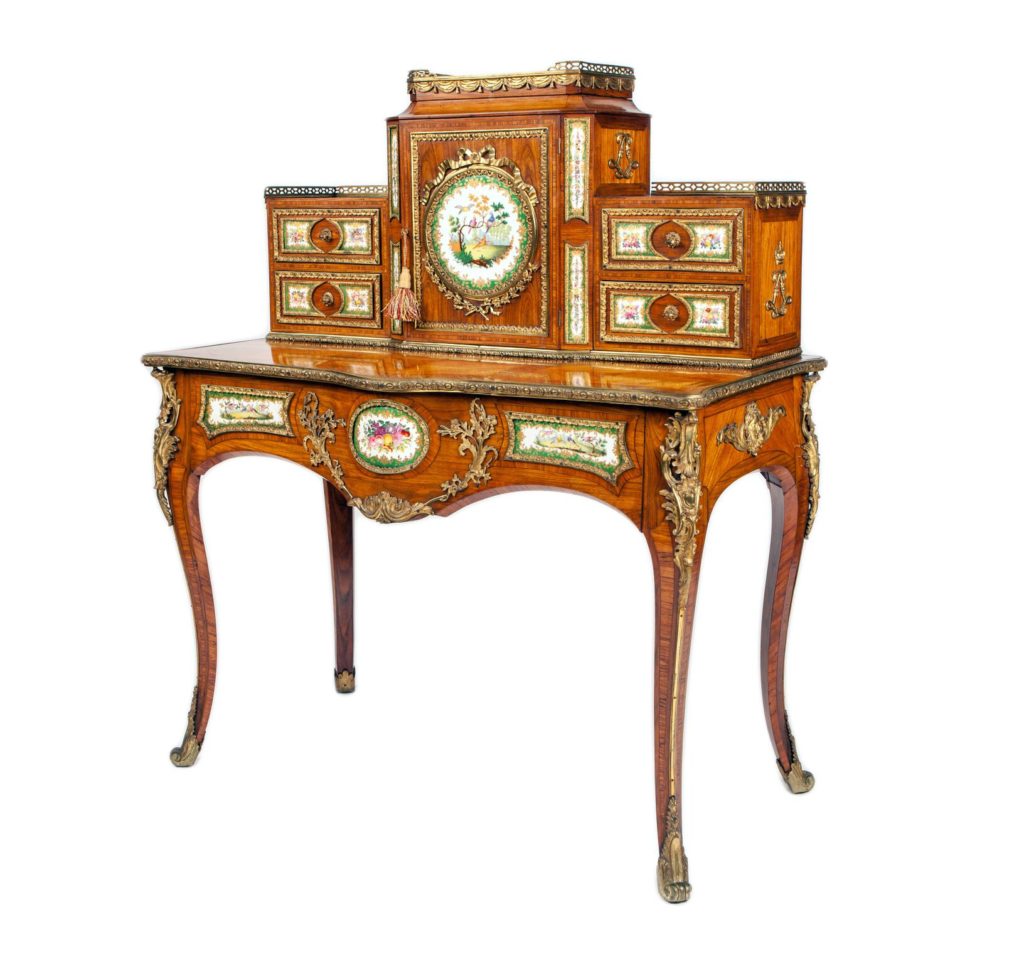
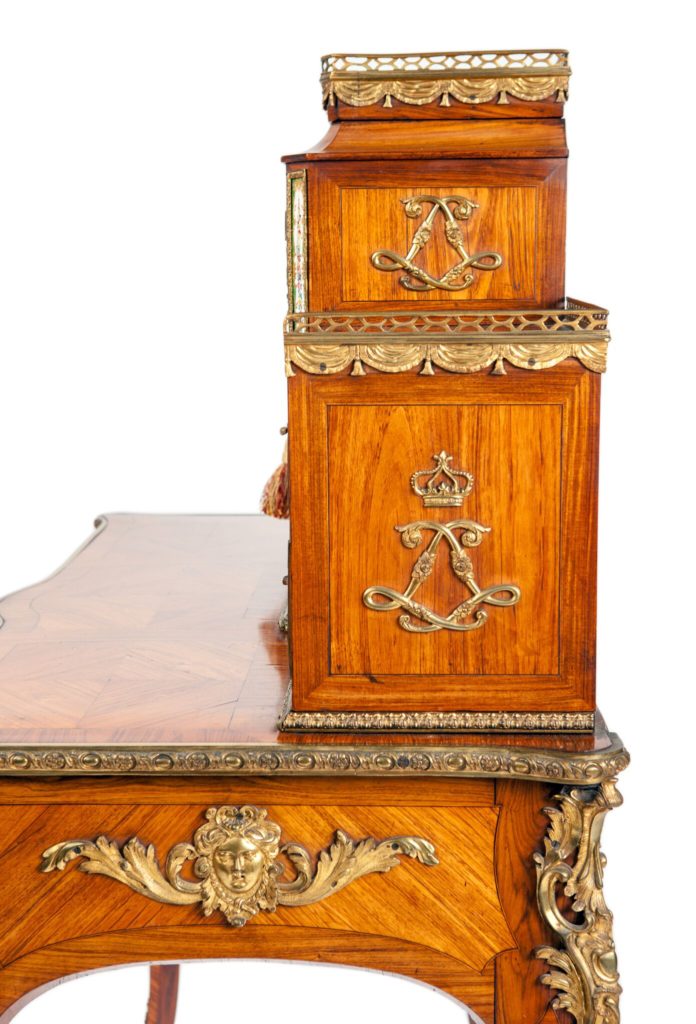
Still, in the old friend department, it was pleasing to see a Downton Abbey apostrophe, or should we say subplotlet, involving Princess Mary, the princess royal, given that now in our own collection we have an exquisite bonheur du jour that was once hers. This brings alive the notion of provenance, and makes one realize that though one may be possessed of the object itself, the spirit of one of its prior owners always remains present and forever imbues the piece.

Bonheur du jour, ex collection of Mary, the princess royal
Cypher of the princess royal, above that of her husband Viscount Lascelles

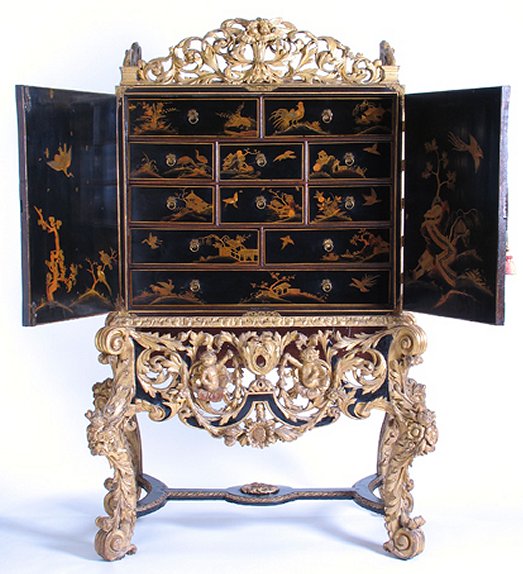
Not everything in our stock has an illustrious provenance, but that’s not to say that at some time something of the sort might not declare itself. We did not so long ago acquire a William and Mary period cabinet on stand, unprovenanced and purchased in a provincial saleroom that, in the fulness of time, determined was disbursed in the 1930’s in a country house sale and acquired by decorating legend John Fowler- and sold to, wait for it, Vivien Leigh and Laurence Olivier for their country home Notley Abbey.

William and Mary period cabinet on stand, supplied by John Fowler to the Oliviers

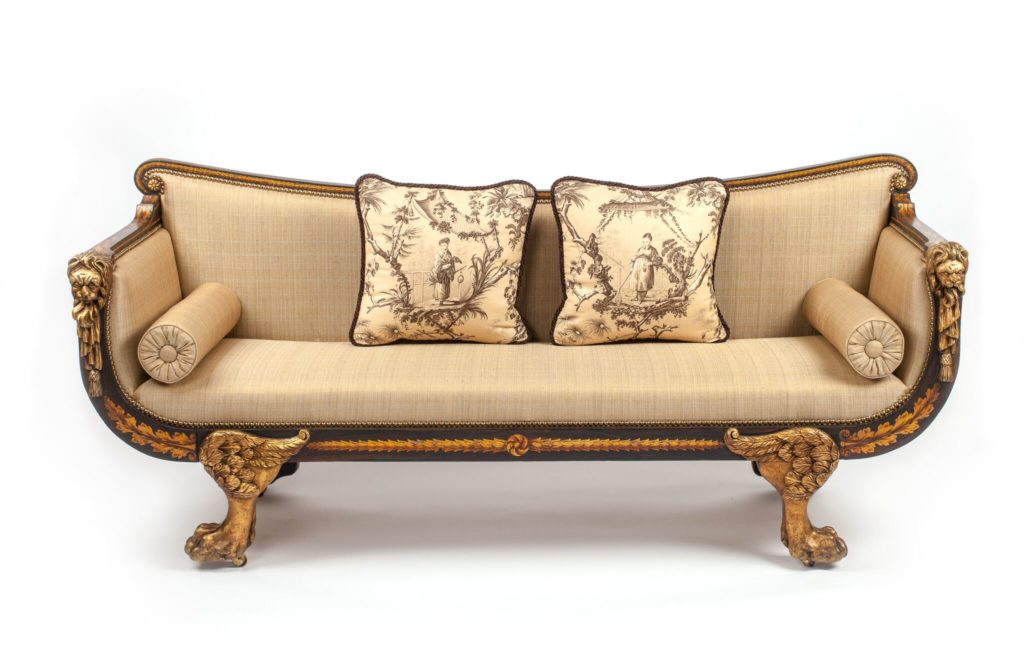
Still, absent provenance, it was of considerable fun while watching ‘Downton Abbey’ on both the big and small screens and seeing items similar to those in our stock. In one of the closing scenes of the movie, Lady Mary Talbot nee Crawley has a tete-a-tete with the Dowager Countess of Grantham, whilst seated on a Regency period settee. I nearly missed the dialogue, though, thinking as I did how similar the settee was to our exquisite example. Shameless as I am, I have to tell you that ours is better. And ever more shameless and venal to boot, I’ll tell you that, for the right price, ours could be yours.

Regency settee, in the manner of Thomas Hope- ala Downton Abbey

Not so long ago, we were asked by the stepdaughter of a well-known antiques dealer who’d recently died to assist her with marketing his huge inventory. That he was not a member of the accredited trade was certainly made manifest when we looked through countless items to only find a few that we could reasonably offer. Nevertheless, after sifting through hundreds we found perhaps two dozen that were of sufficient quality that would then articulate with our stock. That of course was the first challenge, because the dealer had paid a huge amount of money even for the most pedestrian pieces. We had the unpleasant task of negotiating with the stepdaughter, trying to break the bad news of what the items were actually worth, and then making her understand that that figure had to be discounted yet again to allow Chappell & McCullar to make a bit of money on the sale. I freely admit that we endeavor to operate profitably.

As the saying goes, no good deed goes unpunished, and with the items finally negotiated and installed in our gallery and then catalogued and photographed and offered for sale, the stepdaughter phoned us sometimes daily wondering what we sold and if not why we hadn’t- and in an historical reinvention, ‘reminded’ us that she’d done us a signal honor in allowing us to represent her stepfather’s stock. Ugh. We did sell a few pieces, but after a little while- perhaps 6 months- told her to come and pick up her items. We did though have one piece that had had significant interest, but the interested party told us, not as though we didn’t know, that the piece was overpriced, and he gave us a figure- a reasonable one- he was willing to pay. We dutifully communicated this to the stepdaughter only to be met with a haughty decline, and this piece, then, also made its way, unsold, back to its point of origin. Within weeks, we saw this same piece in an auction catalog, with a presale estimate below what we’d offered to pay, and when the piece did sell at auction, it sold even yet below that- at an estimated net to the stepdaughter of 50% of what we had offered a few weeks previously.

One wonders what mental process was at play when upon hearing the auction estimate, prevented the stepdaughter from phoning us to reoffer the piece. Rank stupidity? Well, yes, certainly in this instance but frankly, this same behavior exhibited so often by seasoned dealers who should know better has begged question over and over during our time in the trade. To cite two instances occurring just this week, we received first a communication from a now struggling dealer asking for our help that, when it was offered by us not so long ago, was haughtily spurned. A bit of an aside, although we could clearly read between the lines to suss out the dealer’s straights, the tone was nevertheless couched in phrases that made it seem that in asking for assistance, Chappell & McCullar was being done a favor. It was, further, the gallery manager who contacted us. As we typically would, as the saying goes, rather speak to the organ grinder than the monkey, we responded by saying we would happily discuss these few matters with the gallery owner.

This recent dealer missive comes on top of reading a few days ago in the trade press of yet another dealer who likewise chose not to do business with us, and now closing up entirely after trading for nearly a century. As I reread this last sentence, I find that what I’ve written though concise is misleading. I should say more explicitly, and more germane to the present discussion, that the dealer made our enquiry about their stock and the possible completion of a sales transaction so complicated that it made it seem as though they chose not to trade with us. We will though have an easier time, I’ll wager, when their stock comes up at auction.

Maybe it’s something Keith McCullar and I are doing or not, perhaps sporting the wrong hairstyles or inappropriate attire- couldn’t be poor personal hygiene- but I suspect that what we are doing wrong is what we’re doing right- carrying on our long established practice of contacting people in the trade when we see something another dealer has that we don’t, that we can then sell on to one of our clients. We do that often, including just this week, sourcing an unusual item not typically in our stock for a very good client in the southeast. That he came to us is not out of pattern as he has done so many times over the years, providing items from our own stock as well as sourcing pieces from others, and even on one occasion arranging to have an upholstery fabric specially loomed in Italy.

The ‘why’ of why the client came to us is simple- clients return because the trade is a relationship business, with the client buying not just an object from a dealer, but also buying into the dealer’s manner, cachet and mystique- all these things rendering a look and feel that, for the best dealers, is as uniquely theirs as a fingerprint. We do of course see folks from time to time who we know to be inveterate collectors that never make a purchase but do routinely from others with whom, it is apparent, they are simpatico. And of course, our own good clients do not make purchases exclusively from us- no one, and certainly not us, can claim either a monopoly on relationships or exclusive loyalty.

None of this client dynamic is unusual and I cannot believe that the nature of these semi exclusive relationships has not been cottoned on to by every dealer in the accredited trade. Nevertheless, it astonishes me how obtuse my colleagues seem to be about this phenomenon. Not so long ago, we had a sometime client contact us- a fund manager in Hong Kong, who was seeking a long set of Regency period dining chairs. As it happened, we found a good set at a neighboring gallery, and sold them on to our client. We got some stick from the dealer though when we inquired about another item for a different client, with the dealer’s retort that he was not willing to sell the piece to us, as he’d save the sales opportunity for himself the next time the prospective client was in his shop. What a putz- I guess his comments to us amounted to an egotistical occlusion, unwilling as he was to acknowledge that the client doubtless had already been in, given the dealer the go-by and chose to trade with Chappell & McCullar. I must say, particularly in our old Jackson Square location, this kind of thing happened to us over and over. One neighbor dealer when we would come in to look at something for a client, as we did with some frequency, took to insisting that we tell him for whom we were making the purchase. The upshot of both these stories is, both of these are now shall we say former dealers.

In a trade where collegiality would serve everyone, particularly in tough times, it still astonishes me the extent to which dealers will continue to resist cooperating with those who they insist on considering not as colleagues but as competitors. When the dealer attrition first began apace in our old neighborhood, I brought up my concern about losing what I considered a critical mass of dealers in the area, a massing that would facilitate the area’s and each individual dealer’s success, and historically a massing that had established it initially as a shopping venue, and a massing which would secure its survival. The dealer to whom I expressed this concern upbraided me, telling me that I was stupid, that with the departure of any dealer, what sales he was enjoying would now flow to those of us who remained. This mindset functioned so successfully in his business that he, too, is now a former dealer.

It would be ridiculous of me to claim that the vicissitudes of the trade in art and antiques haven’t been affected by changes in the environment in which business is done. Online sales have had the same effect on the trade as on every other bricks and mortar retailing, rendering them nearly obsolete. Dealer platforms, functioning as they do to present a wide variety of material on a single page provide a

shopper with a virtual antiques and art fair, and have rung the death knell for the actual live see-it-and-touch-it antiques and art fair. And too consuming patterns have changed with a younger generation, with the opportunity to have cheap and cheerful furnishing and decorative items, available any time and on a budget- and with free shipping. Vintage items with some but not much age and hardly antique, also available through specialized online platforms, now are used to add interest to modern décor, displacing better quality period material.

Even so, and with so much Chappell & McCullar business conducted through our website, we’ve found that our own specific look remains transcendent, not just keeping our existing client relationships intact, but providing inroads into new ones. Any why not? We still use the same amount of care in the acquisition of our pieces, and as I hope my gentle readers have discerned through your dedicated reading of my blog posts, we still communicate with our clients and the world at large in the same voice.

And, as just cited, we still have clients that require something that isn’t strictly in our line. And we yet enquire about pieces to satisfy a clients’ requirements, shopping our colleagues in the accredited trade first. We don’t experience the same shall we say resistance as we did a few years ago when we shop, but then, there are markedly fewer dealers.

But it still exists- with a driving attitude I’ve now termed pernicious egotism. Take note, my colleagues who read this- whatever we have, we’re happy to offer it to you for sale- just ask me. But that won’t happen, or at least it has rarely happened in the past. The point of all that I’ve written in this entry is that, with all the difficulties in trading conditions, and those conditions continue to decline without any sign of abating, egotism exacerbates tough times. I’ve twice characterized specific dealer attitudes as haughty in this blog- would preplacing haughtiness with pleasant congeniality change things? Perhaps, or perhaps not, but it wouldn’t hurt. What I can point to based on our experiences just this week is that pernicious egotism will it sadly appears, survive as long as the trade survives.