
© Banksy

In September, Christie’s will hold an online sale of works by illusive artist Banksy. The sale title itself is presumably drawn from the artist, and completely titled ‘I can’t believe you Morons actually buy this sh*t.’ The asterisk of course inserted by Christies, although I can’t think why.

The work may be by Banksy, or may not be, or may be the production of a number of people, crypto artists, who work collectively under the name of Banksy- all of which possibilities are of appropriate Banksy-an fashion. In a tradition of street art that goes back millennia including more recently the likes of Jean Michel Basquiat, Banksy functions to redefine the nature of artistic production, and changes established notions of what should be included in the artistic canon.

Or not. Frankly, as the title of the auction suggests, Banksy is laughing at the effect he’s having on the world of collecting, and while he laughs, for myself, I’m mystified. But then, the 20th century has been nothing if not replete with the work of those whose artistic production was not understood but yet lionized the result of promotion by both the critical and commercial art sales community.

Those of us in the collecting world, and that includes Keith McCullar and me, inveterate collectors who maintain a presence in the retail trade largely to support our collecting activities, have been laughed at before. Picasso was self descriptively quoted in arts journalist Giovanni Papini’s 1951 Il Libro Nero as ‘only a joker who had understood his epoch and has extracted all he possibly could from the stupidity, greed and vanity of his contemporaries.’ Rather an insulting indictment of those whose support made Picasso one of the overarching cultural figures of the 20th century. This statement was published a few years after the death of his uber patron Gertrude Stein. Would he have made this statement were she still living and dared risk being put in place and diminished by her withering riposte?
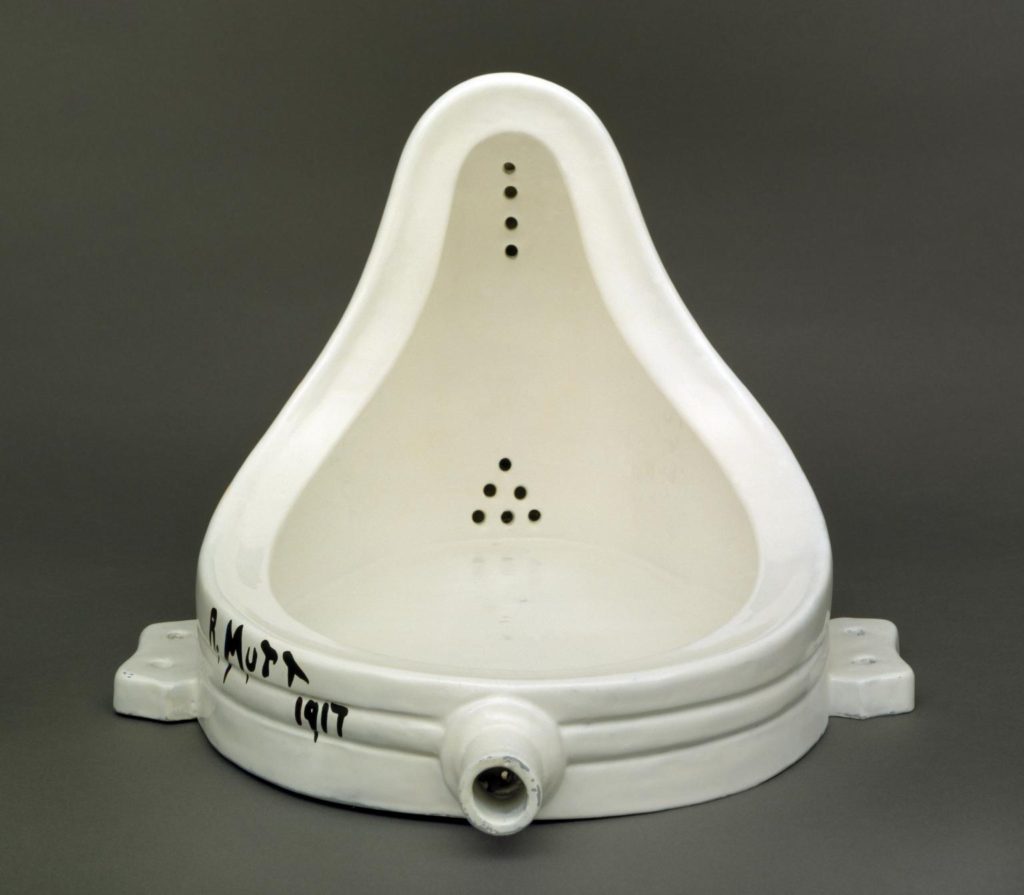
Although there is some dispute about Papini, with claims including by Picasso that the quote was fudged up, there are nevertheless manifold examples of works by artists of similar vintage who sought to point up the idiocy of humanity when it came to art, which idiocy was concretely enshrined by the elevation into the canon of shall we say ‘controversial’ works. One of my favourite examples, and the one I always brought my students to see at Tate Modern, was Marcel Duchamp’s 1917 ‘Fountain’, the upturned urinal that is the quintessence of Dada. Even 100 years on, my students, despite having read a considerable amount of art criticism beforehand yet found it nearly impossible to come to terms with the object. My students’ confusion and consternation give witness to the fact that, had they more self-confidence, they’d know they were on to something- but placement in a museum of size and reputation as Tate Modern cowed them, intimidating them into thinking ‘Fountain’ was something beyond what it was. Pride of place in an art museum works to flimflam most people into thinking that something must prima facie be respected as of museum quality.

My students were overthinking what it was they saw, when actually the pathway to a site of meaning was simple to navigate- if the artist says it’s an art object, it is. And if museum curators along with the rest of us are stupid or gullible enough to esteem it as one and can create some kind of critical framework in support, well, what can I say? In my academic career reading art history, I would frequently come across the trope generally referred to as the emperor’s new clothes. We all remember the nursery story, of the gullible emperor, duped by the tailor who told him that his fine albeit imaginary raiment could only be seen by those as wise, virtuous and discerning as the emperor himself. It then took the honest, guileless questioning of a child when the emperor sought to display himself that when the obvious was pointed out publicly, all admitted that in fact the emperor was entirely naked.

As often as the trope of the emperor’s new clothes is referred to in art history, it is very, very seldom employed. Most generally, it is the commercial, collecting and even the scholarly community who lionizes work that even the artist himself thinks is at best trivial, or downright no good. Or, as Banksy has it, sans asterisk, shit for morons to buy.
In the last round of Democratic debates, Mayor Pete was asked about a racial incident involving a police shooting. Mayor Pete owned it, acknowledging that it was a black mark on the city he governs, and likewise acknowledging that the police force while making progress has a long way to go before it is sufficiently diverse to match the community it serves.

Frankly, the candor, humility, and intelligence that Mayor Pete has shown consistently has gained him considerable traction, witness his appearance on the debate stage- adjacent, tellingly, to the veteran Joe Biden. And Joe could take a lesson from Mayor Pete.

It must be said that Joe’s longevity and success in the public arena, and the personal enjoyment and good humor he almost always exhibits, reminds me no end of another successful Democratic politician of not so long ago, Hubert Humphrey, whose soubriquet was the happy warrior. With all that, Joe Biden’s length of service has a dark side, which Kamala Harris sought to exploit in the debate. This country’s emergence from separate- but- not- equal, Jim Crow legislation is ongoing and not done yet, but was certainly nearer the beginning than it is now when Senator Harris was a schoolgirl. Her criticism of Biden’s past actions while legitimate is along the lines of 20-20 hindsight. In Biden’s early career, he had to deal with a block of legislators that we’ve now nearly forgotten, southern Democrats whose longevity in office made them senior on nearly every committee in the house and senate and successfully obstructionist beyond anything we currently see in Congress. It was this environment that Joe had to navigate to accomplish any progressive reform. That some of these were achieved with compromises made with arch Dixiecrat James Eastland should not in any way be interpreted as Joe’s wholesale embrace of Eastland and Eastland’s racist agenda.

Keith McCullar and I have just embarked on the beginning of the 40th year of our relationship. Yes- 4-0. But it is only in the last 5 years we’ve enjoyed the entitlements that come with the legal recognition others enjoy, and the tax and social security benefits that we’ve paid for but heretofore had no right to receive. For Keith and me, we should have a large picture of Joe Biden in pride of place in our home- with a halo above it- as it was he who as vice president publicly moved the support for marriage equality to the executive branch of government. In terms of Joe Biden hagiography, I believe Mayor Pete would agree, and like us, would further agree that Biden’s progressive creds are eternally established.

In an aside in the debate, while Mayor Pete concluded his mea culpa about the racial incident in South Bend, debater Eric Swalwell said aloud that Mayor Pete could have fired the chief of police. It is ironic that Swalwell, whose ageist refrain during the debate, and before and afterwards, was how the older leaders of the party needed to step aside for those, like him, who are younger, he advocated the oldest of old political ploys- find someone to blame. Without any specific knowledge of what had gone on in South Bend, Swalwell’s ‘solution’- and one often favored by President Trump- was to find a fall guy and dispatch them publicly.

With all that, there is no question that so much of what was done not so very long ago moved racial equality forward in this country with glacial slowness and Kamala Harris’ comments are, excuse my understatement, well taken. But the fact is, Biden did the best he could with what he had to work with, and it is hardly fair and entirely unproductive to second guess events 4 decades hence. Mistakes were made, but the tortured, circuitous course of history can’t be rewritten, but perhaps its sting can be, well- ameliorated. Just take a lesson from Mayor Pete-own it, Joe, and acknowledge that we’ve yet a long way to go. But also be quick to point out that Kamala Harris- and Mayor Pete and Cory Booker and Elizabeth Warren and Julian Castro- are, in no small part due to your redoubtable efforts and decades of public service, now sharing the public stage with you.


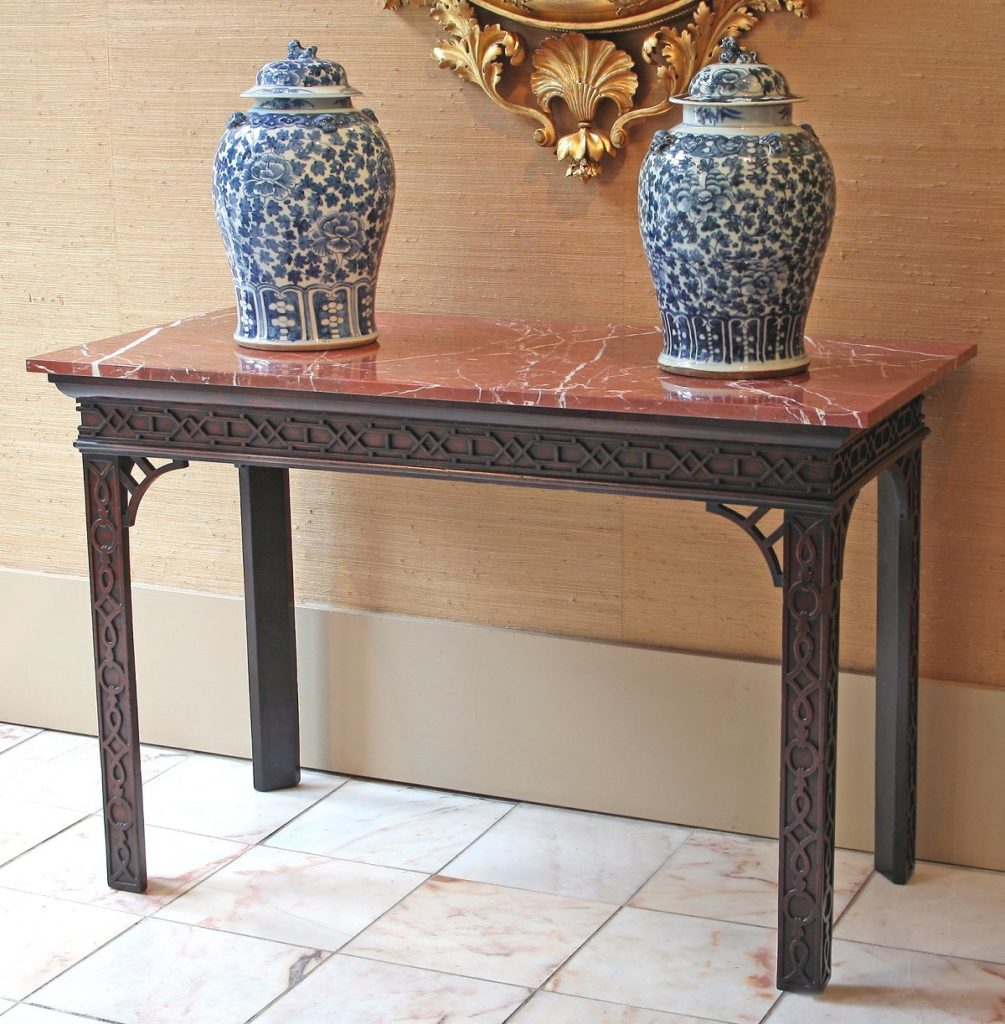
Chinese Chippendale- on sale and sold online

It has for years been my sad refrain- the traditional trade, not just in traditional material but its traditions of marketing through bricks and mortar locations in proximity to like dealers and likewise amongst like dealers in the best fairs- that these ways in which to connect with clients new and established were quickly going the way of the dodo bird. For Chappell & McCullar, stalwarts in late years on Jackson Street in San Francisco and innumerable fairs in the US and the UK, we’ve been sadly witness to the death of very many fairs of decades-long tenure, and the complete disappearance of venerable Jackson Square as a venue for fine art and antiques.

And the replacement, I hardly need tell you, is the virtual storefront- even during our waning years on Jackson Square, the lion’s share of our sales were online, and nowadays, virtually all are derived from our virtual presence. We log as diligently our online statistics as we ever did the names, details, and preferences of those visitors who we were pleased to have darken our Jackson Square threshold. A sidebar, though- it shouldn’t surprise me that the business has headed the direction it has. While it has always seemed to me that, though we treat our stock as a fungible commodity- with established criteria for value and quality- clients would forever in the future wish to see, touch and in every way examine at first hand what we had to offer. With all that, from the very first, our gallery visitors always when asked told us that precedent to their visit, they had browsed our website.

So I shouldn’t be surprised that after very many years, the virtual has displaced the actual, and perhaps what I express as surprise is more than slightly inauthentic. What I really am is nostalgic for the old, high touch interaction between object and client and dealer.

I suppose my gentle readers might link the traditional material that is our stock in trade with my fondness for the traditional methods of selling it, but these traditional methods pervade all manner, including the edgiest of contemporary art. One only has to read the art press for a few weeks to discover the vicissitudes experienced by the contemporary art fairs, including the most recent Art Basel. While so many marques- Masterpiece, TEFAF, and Art Basel- continue to try to reinvent themselves to attract buyers, ‘The Canvas’ is reporting something at Art Basel that is astonishing. Contemporary dealer stalwart David Zwirner actually had an online viewing room at his stand offering what the dealer termed a ‘parallel art fair experience.’ Or, put another way, letting a fox into the art fair henhouse. Clearly, Zwirner knew what they were doing, selling items online at the fair into the 7 figures.

Mind you, Zwirner, Hauser & Wirth, and Gagosian are deep pocketed heavy hitters in the contemporary market, and though for the moment they are committed to not just fairs, but also bricks and mortar in addition to the virtual ‘parallel art fair experience.’ Still, an attachment to traditional methods was fatal to Partridge and Mallett on Bond Street and Kentshire in New York- for decades the most overarching presences within my sphere and now only of blessed memory.


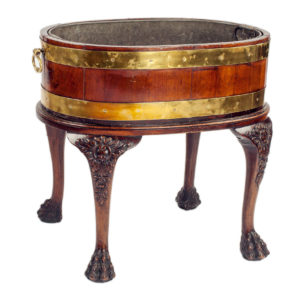
Irish Georgian wine cooler, on our Summer Sale

All one’s life is a confluence of events, or should I more accurately say phenomena, that once several come together in a situation of synchronicity are then elevated to the status of ‘event’. Herewith several of today’s phenomena.

Firstly, of course, is our annual summer sale. For those few of my gentle readers who don’t know the why of this, let me begin by saying that, with our business started in July, 2002, the summer provides Keith McCullar and me the opportunity to annually review what’s sold, and what hasn’t, and then price the ‘what hasn’t’ to move out the door. This is wrenching a bit, as Keith and me, using our collecting passion as a springboard for the establishment of Chappell & McCullar, are really happy, from an aesthetic standpoint, to keep close at hand very nearly everything we’ve ever acquired. Not practical, to say nothing of the expense, and it as well inhibits us from doing something else- sourcing additional fine quality pieces. From our prior backgrounds in finance- me in banking, and Keith as a chartered accountant- our rule- not entirely immutable, but something we try to work within nonetheless- is to price whatever we have to sell within two years of acquisition. If unsold at that time, we discount it to move it to sell it at our summer sale. We are not inordinately disciplined people, but Keith and I have stayed pretty close to this rubric. Has this practice then served us well? Witness our survival in business, where so many others have bit the dust. Mallett, Kentshire, Partridge- all redoubtable names and all, in the last ten years, consigned to memory.

The second of today’s phenomena was communication with a TV production company regarding a fly on the wall program specifically about the retail trade in antiques. That this should have come our way says something about our survival, in that those formerly vaunted names, now gone, have allowed some of the rest of us to, as it were, waft to the surface. This sounds self-congratulatory and conceited, but I suppose in any business, as in so much of life, one key to success is the mere fact of survival. But as tough as things are in the trade, indeed in any retail endeavor there is nothing ‘mere’ about it. Ours is a business and it is that we treat it like a business that brought us to the attention of the TV production company.

The last phenomenon was the bit of wisdom I received via email from a local estate agent. That is to say, received from a gentleman born locally who has been our good friend for a number of years, and who is principal owner of one of the nation’s largest estate agencies. By way of staying in touch, he sends out several times a week little anecdotes and homilies, words to live by, and other uplifting bon mots. Though some might characterize these electronic missives as spam, received of a friend for whom I have a high regard makes me inclined to read what’s sent. Today’s was about getting on with it- a writer should write, a composer should compose, or as quoted of Samuel Johnson ‘Nothing will ever be attempted if all possible objections must first be overcome.’ This is probably the most appropriate communication from our friend, who we know to be a man of action. Confident and successful, albeit with a mistake now and again, but as he quotes this time Benjamin Disraeli ‘Action may not always bring happiness, but there is no happiness without action.’

So, with these three phenomena we’ve syncretized the event that is our annual Summer Sale, as what is for us our best plan for continued success in the trade. Yes, mixed emotions of course as I will miss the pieces that will inevitably make their way into the sphere of someone else, but then, that’s true of everything we’ve ever sold- but know sales result in plenty of other opportunities. For my gentle readers, then, not an exhortation but an encouragement- browse our Summer Sale, tell us what you like, and we’ll have a real meeting of the minds and know that what you like is well liked by Keith and me.


It always surprises me that we’ve become old lags in the trade, as I suppose we have with our 20-year tenure. That of course the industry has been in flux and thinned out at the top has functioned to waft us, based not just our longevity but the fact of our survival, closer to the top. But with all of that, it seems that our experience has provided us not just with a welter of stories, but the ability to hive those stories into a variety of categories, and it is one of those categories I’ll relate now.

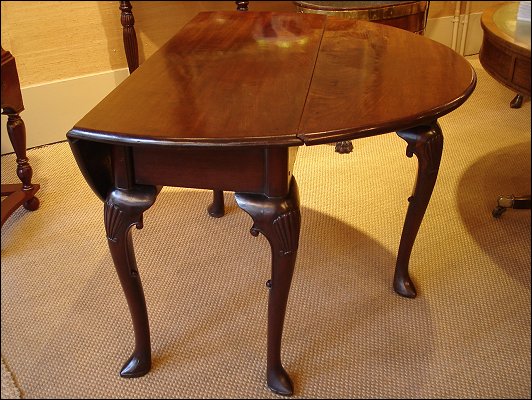
George II period table- irresistible to touch

Amongst our many gallery visitors, we quickly learned there was a class we dubbed ‘touchers’. Initially, that a visitor was hell-bent on touching particularly furniture pieces with a flat surface was just an annoyance. The fact of bringing one’s fingertips across the surface of a table, say, means that I will upon the toucher’s departure have to bring out the dust cloth and buff out the inevitable fingerprints and smudges. While this sounds like the act of someone inordinately house-proud, I will remind my gentle reader that there is of course a commercial imperative- we do sell these pieces from time to time, and showroom condition supposes an absence of grubbiness.

In the fulness of time, though, the inconvenience wrought by the toucher was replaced by real irritation because it became apparent that touchers never, ever made a purchase. I suspect there may have been times, though these don’t stand out in my memory, that we have even told gallery visitors not to touch. If we expressed this in a vocal tone mezzo forte in a minor key, I do apologize.


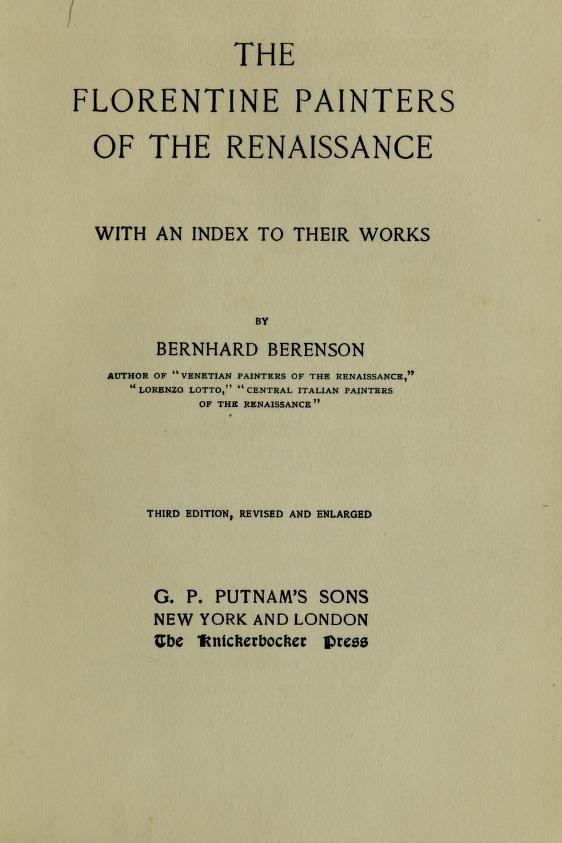
Berenson and ‘tactile values’- ahead of his time in 1896

And I really mean it because, after too many years it finally occurred to us that the touchers’ action was really complimentary to our stock, and by extension, to us. The tactile contact, we came to discover, was a way by which a person who for whatever reason couldn’t make a purchase could still achieve some kind of connection with a decorative item that spoke to them. ‘Resonance’ is the current term, and I think it is as good as any to describe an experience between either an animate or inanimate object that sparks some kind of positive interaction, and so it has been for touchers- something resonates with them. It might be something they will never own but they do wish to enhance their resonance by touching it.

For those of you with a critical bent, you’ll find all of this familiar. What I term ‘resonance’ Bernard Berenson had more precisely defined over 100 years ago as ‘tactile values’. For Berenson viewing a painting of the Florentine renaissance might stimulate an aesthetic experience analogous to the physical act of touching. While our own stock is a bit thin when it comes to paintings of the Florentine renaissance, the decorative items we offer do share some commonality in centuries of age, and centuries of contact with humanity. It has been my belief that this imbues all these items with a real spiritual energy. Manifested as ‘tactile values’, ‘resonance’, or just plain touching, this spiritual energy is felt by very, very many people. Bearing this in mind, touching becomes irresistible.