

‘Life must be lived moving forward, but can only be understood looking backward.’ Where was it I read this bit of worldly wisdom? Perhaps a fortune cookie, and I have to say, I never discard any fortune cookie fortune, placed there and finding its way to me I’ve always sensed the result of some grand design.

I was thus reminded of this aphorism when I watched ‘The Andy Warhol Diaries’ on Netflix. Reminded, but also made cognizant of its subjectivity. On the one hand, the show, derived from the diaries, is thorough going in attempting to present in his own words a long-ish slice of the artist’s life, but on the other, as a slice it was perforce limited as the scope of the diaries was limited to the later years of Warhol’s life. And when it might arguably be said his fame was in something of an eclipse, not reinvigorated until the publication of the diaries some years after his death. As it was, a number of those interviewed for the Netflix series, in a rather extended epilogue, were critical of the diary’s editor Pat Hackett, with the most common claim that she was selective and subjectively tendentious in her editorial approach. While it may have been Warhol’s narrative, the diary as presented expressed only what of the artist the editor thought she knew.

And herein lies the tale. I am 11 years older now than Warhol was when he died. His own diaries were largely that, a recordation of the minutiae of his everyday life, and it was from them that one would, if one chose to, abstract varying bits of something akin to reflection and from those bits weave together some manner of personal philosophy. Serving as my own exemplar, I can say that it is only in the last couple of years I’ve begun to be sufficiently reflective, poring over the details of my life, recording them in a journal, and the result of my own periodic review, monitor my progress toward the rudiments of a self-knowledge that might form the bases of a personal philosophy. An involved process, or should I say processes, of for me at least many years duration.

Moreover, all of us, every single human, until they die, are the quintessence of a moving target, a constantly filling repository of experience, and some claim that experience and one’s reaction to it carries on beyond death. I do not disbelieve that and place it on a par with fortune cookie wisdom. But as one considers Andy Warhol, what we know of his early life, and what we know of the incident crowded years of The Factory, including Warhol’s near assassination, it would indeed be difficult for even a person deeply reflective to begin to assimilate, much less make philosophical sense, of such an experiential welter. And, frankly, I very much doubt that Warhol was possessed in any large measure of that particular facility. His genius was in reacting in unique, and arguably facile, ways to ordinary human experience. Witness, of course, the pop art that was his initial claim to fame and established him in the canon of art history. Contrast this with the angry and cerebral work of those ab ex artists who barely predated him. Warhol and his retinue were a marginalized group of shall we say misfits and miscreants, but witness their hedonism, arguably less angry, and in fact, where Rothko and Pollock made no headway in exorcising their demons through art, I would argue that Warhol and those denizens of The Factory at least more effectively sought to, expanding the repertoire to accomplish this with not only traditional art, but film, television, and happenings. Remember ‘happenings’? If you do, then you’ll have to admit your age, and hopefully this will spark some reflection that might assist you in personal insight, furthering the development of your own philosophy. You’re welcome.

No diary or biography ever does express or could explain the whole of anyone, even if it extended through and was as long in its recordation as the entirety of the life to which it was attached. And then, too, there are the twin issues of interpretation and point of view. Pat Hackett requires no apologist, but suffice to say what she edited covering only a few years had the inherent problem of brevity, and with how many characters related therein, and how many subsequent readers post publication, yielding innumerable, and deforming, points of view. She did pretty well, all things considered. And a finite understanding of any aspect of Andy Warhol? It might have been available to the man himself, but will never exist for the rest of us. We can agree that he was enduringly fond of Campbell’s Soup. Note for future biographers- I am enduringly fond of arugula.

The major news flap this week surrounding the Facebook whistle blower puts me in mind of our own experiences with social media which, it appears, forms a significant portion of what is now described in common parlance as big tech. As I am writing this post on my Dell desk top utilizing Word for Windows, for me, big tech means something else. Social media should more appropriately be termed ‘noisy tech.’

But no question, whether big or just noisy, or noisome, social media has remade all of us for the convenience of some and the detriment of many. So many, apparently, and in such an insidious way and with such dire results, those who seek to regulate this portion of big tech liken it to the big tobacco of an earlier day. When I had initially heard this comparison, it seemed overstated, but then the more I’ve heard and read, the more appropriate the comparison is borne out, even by social media’s own internal reckoning. Similarly, big tobacco before being called publicly to account knew in detailed terms the horrific effects its products were having on users. Despite for years posting the required warning labels on its tobacco products, companies have never to my knowledge really acknowledged any real responsibility. Likewise, the major social media platforms, while saying publicly they are working to ferret out problems have never acknowledged their own complicity, or culpability.

Still, as with big tobacco, social media companies know and can profitably rely upon the knowledge that there are millions, or more probably billions, of the weak minded who will intentionally put themselves in harm’s way.

As well as the technology employed to pen this post, all of my gentle readers will have accessed it through some arm of big tech, most likely through a search engine, so what I’ve written above might seem to make me out a hypocrite. I’d like to think that, as I do not smoke, I can also, possessed of moderately good judgment, with reasonable safety employ big tech in a productive way. But I have to be honest- though I can’t say that I have been the victim of body shaming, my own shall we say discreet use of social media has been influenced by some negative incidents.

Years ago, when we established our own page on Facebook as what appeared the coming thing, I sought to expand our commercial reach through attracting what were then and are now termed ‘friends’. Mind you, when I use the word, it means something different than the tangential point of commonality that is meant when it is employed in social media. Can you imagine, though, clicking on a request to become someone’s tangential point of commonality? So I suppose, in this context, ‘friend’ becomes useful shorthand, though for me it has, sad to say, become a neologism.

Still, we have attracted so many friends to our social media platforms we are now informed by several platforms- through messages sent on their own platforms, of course- that Chappell & McCullar are now, wait for it, ‘influencers.’ As this is something new to me, you’ll pardon this question posed in a contemporary idiom- is this a thing? Apparently so, and as I have seen people so designated on social media, it is also apparently a vocation, albeit an ephemeral one.

I should further say it is a poorly paid one. Frankly, our own social media posts have been nakedly venal, almost entirely for the purpose of supporting our core antiques business. This naturally begs the question, has it helped? And as with any other promotion we’ve ever employed, the best I can answer is, perhaps, but as with any other promotion, there has been a cost.

No, no revelations here about body shaming, but several weeks ago, in response to a blog post on social media, one of my ‘friends’ took me to task, online of course, with her terse criticisms employing terms like ‘wanker’ and ‘left-wing asshole’ with her tirade concluding with a demand that I, wait for it, ‘unfriend’ her. ‘Unfriend’ is also a thing. By the way, I had never otherwise had any interaction of any sort with this erstwhile friend, and the why it was that when reading my posts she did not take the first step and seek to unfriend me is a mystery, beyond the fact that, had she done so, she would be denied the opportunity to call me a wanker.

Hopefully my gentle readers have found that my social media posts are not primarily a virtual cudgel for online invective, and as I use it mostly to promote our business perhaps it is similarly useful to some of our colleagues. A trade association of which we’re a member held an online seminar about how to use social media effectively, with one of the key takeaways that, when one’s page is ‘friended’ or ‘followed’, or ‘liked’, one must reciprocate, friending, following, or liking in kind. I pity those of my innocent colleagues who took on this suggestion wholesale, as they’ve doubtless found many of their ‘friends’ to be a bewildering number of porno websites. For those who have attempted to use paid promotion to further their social media presence, many are frightened to find sometimes successful attempts to hack their credit card accounts perpetrated by friends let in to personal information by the virtual front door. A sidebar- it astounds me that so many of my colleagues post online, real-time events including where they are on holiday, and then shocked to find upon returning their home has been broken into and ransacked. When I see these fun holiday posts, it is all I can do to refrain from commenting ‘Is the front door key still under the mat?’

No question, social media has a lot to answer for, but, too, just like the putz who continues to smoke, or like most other things in life, come to that, a level of personal responsibility must be undertaken. No, no one forced me to be online, and no, no one forced me to smoke that cigarette, no matter what the blandishments. A final sidebar- we do have a couple of clients who are at the most senior management level of big tech. Their purchases of our traditional material, for those of you interested to know, were made not virtually or in response to a social media post, but in the traditional way, by coming in through the actual front door and shopping in person.


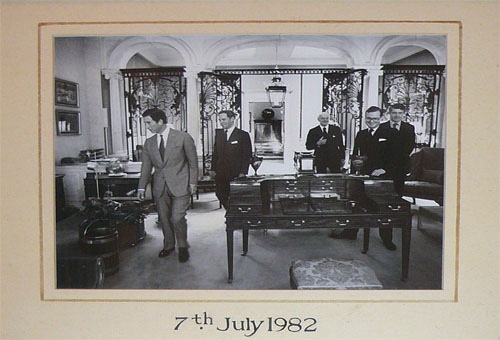
The Prince of Wales visits Mallett

The Antiques Trade Gazette is reporting that troubled coin and stamp dealer Stanley Gibbons Group, who retained the Mallett brand in the US having sold if off in the UK in 2018, is nevertheless moving this once vaunted name into Chapter 11 bankruptcy. The company had through its Mallett subsidiary retained the lease on its former shop premises on Madison Avenue following its closure, subletting to luxury fashion brand Stella McCartney.

Stella McCartney, however, stopped paying rent to Mallett in April of last year, and consequently, Mallett was unable to pay the underlying property owner. According to the ATG, the property owner was unwilling to extend payment terms on the rental arrears and consequently, Mallett had no choice but to file bankruptcy. The Chapter 11 filing, allowing for a reorganization will doubtless convert to the more final Chapter 7 involving a liquidation of all assets to satisfy creditors, the largest of which must be its New York landlord.

A sad and ultimately final end to a vaunted company that began in 1865 and was for over a century at the pinnacle of success within the trade. Moribund in England, its Bond Street leasehold has long since been taken over by Fendi, one of the many luxury brands owned by French conglomerate LVMH.

What I find interesting in the present chapter of the saga is somewhat less about Mallett than it is how so early on in the pandemic luxury fashion retailer Stella McCartney stopped paying rent on its Madison Avenue premises- little more, if one can recall recent events, than a month from the declaration of the COVID pandemic. One wonders whether this ostensibly well capitalized luxury brand was either brazenly opportunistic in taking financial advantage of a global catastrophe, or so thinly capitalized that an immediate drop off in business resulted in stopping payment of rent out of an immediate economic necessity. I suppose looking at it from the latter perspective, it is perversely democratizing when someone as elite as the daughter of Sir Paul McCartney shares something very much in common with the now-defunct shave ice vendor formerly around the corner from my home in Hawaii.

And then the question begs how fares the Fendi boutique on Bond Street, Mallett’s former flagship location. I’ve not heard specific rumblings, but then, the major landowners in the West End, which includes the Queen herself and the Duke of Westminster, are renowned for their deep pockets. But then, neither are they known for unending patience when it comes to money matters. As I’ve always maintained, no matter how wealthy you are, there always has to be a payday.

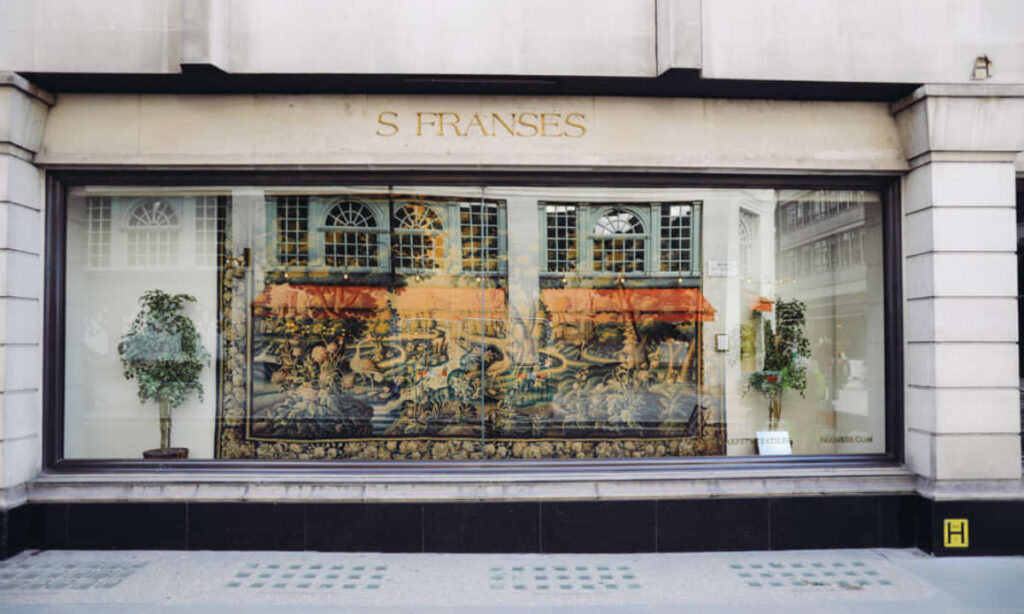
S Franses, Jermyn St, London

It is as they say an ill wind that doesn’t blow somebody some good, and while I can’t honestly say I’ve shed too many tears for the international luxury retailers who’ve in the last 20 years nearly obliterated the existence of independent shops in the better venues, it might be a sign of hope for those few who remain. It is certainly my especial hope that the retail trade in art and antiques, virtually swept away the result of rents that became ruinous, might find the economic tide turning in their favor. Several weeks ago, also reported in the ATG, longtime Jermyn Street dealer S Franses was able to prevail over the predations of his landlord, and promises to stay put for years to come. Hopefully this harkens better days by way of cheaper rents ahead for those of us who survive in a business, albeit a beleaguered one, we love.


Pierre-Auguste Renoir, ex collection Virginia Museum of Fine Arts, image courtesy Freeman’s

We do from time to time welcome student groups from the local university, and one student in one such group asked upon visiting whether any of the items in our inventory were, in her words, ‘museum pieces.’ My reply was ‘All of them or none of them.’ Momentarily glib, I’ll admit, it did serve to beg discussion, with museum culture, as my gentle readers will know, being one of my favorite topics. I happily explained that what ends up in a museum does so because someone made the decision to put it there, and that ‘museum piece’ by which was meant ‘museum quality’ is the result of an entirely subjective judgment, and given the masses of items being deaccessioned, hardly an enduring one.

Let’s back up to the point of beginning, the why of museum’s acquisitions in the first place. Certainly in the case of survey art museums, a huge quantity of material is on offer- gratis. As most museums now devote a significant percentage of their exhibition space to living artists, it is typical for an artist exhibiting to donate one or more, or many, of the items on exhibit to the museum that fielded it. And once offered, it is the job of the museum’s accessions committee, headed by its chief curator and usually composed of several museum trustees, to determine whether or not to accept the items offered. Too often, too many pieces are accepted the result of several factors that are endemic to most museums. In the first place, very few museums have a clearly established policy about accepting artwork, and certainly in this day and age where museums are struggling and are grappling with what it takes to ensure their very survival, it is easier to just accept an artwork than to risk hurt feelings and subsequent claims that, in not accepting an artwork, the museum is somehow at least indifferent, or even hostile, to a portion of its constituency.

In palmier days, when survival was less concerning, one might think accessions could be more rigidly controlled, with its constituencies more established and less in a state of flux. If you thought that, you’d be wrong. The survey art museums have always been about money, and the constituency that mattered almost solely was the great freemasonry of the rich. In the United States, if survey art museums in the bigger cities have a European feel to them, that is because in the 19th and early 20th centuries, US museums consciously sought to ape their European predecessors, aided by the likes of Lord Duveen who found eager customers in, to name two, Andrew Mellon and Arabella Huntington who fervently believed that high culture in America had to be imported from Europe if it were to exist at all. With all that, for every Gainsborough ‘Blue Boy’ there were bales of sort of looks like but not really the same that went on the walls, with museums built at a faster rate than there were artworks of quality to display in them.

So, what have museums got? Masses of artworks and other objects acquired under a variety of different rationale, none of which really conform to any precise rubric. And once acquired, for most of them, their fate is to languish in some storage facility in the basement. I wrote ‘languish’ when in very many cases it would be more accurate to say ‘molder’ as even under the best storage conditions, many items, and particularly paintings, gradually disintegrate. I am reminded of the lament of a museum curator who told me how, in a few short years, a proud signature of a famous artist, scumbled atop the design layer of one his best works, gradually flaked off. Take it from me, paintings, period furniture, indeed most works of fine and decorative arts are dynamic in their materials. Oil paintings typically require significant restoration, even if held and exhibited in optimal surroundings, at least once a century. That might seem infrequent, but as a reminder, the major museums in New York, Los Angeles, Kansas City, Omaha, and San Francisco and all points in between, and their corpus of collections, are well into their second centuries.

As most of my readers will remember, and flying in the face of the horror and castigation expressed by the Association of Art Museum Directors, my answer to any museum grappling with deaccession is a simple one- sell. There is nothing to be ashamed about, and given that most museums, perhaps all of them, have masses of material that will never otherwise emerge from storage in the bowels of the institution, why ever not? As I’ve written so often before, and as recently as my last blog, in these times survival is the name of the game. We’ve seen over the last couple of years lots of face-saving maneuvers employed to justify deaccessioning, with a favorite at the moment attempts to achieve racial equity in balancing collections- selling off artworks to fund acquisition of works produced by those of, say, gender and ethnicities that more closely match a museum’s changed constituencies. Laudable, but newly acquired artwork is just as expensive to maintain as what’s already in the basement.

And what’s already in the basement might be a bit easier to turn into the cash most museums now find they have in fearfully short supply. In reading the monthly newsletter of an East Coast auction house who maintains an active department specializing in deaccessions- and most auction houses now have them- I was reminded of the sale earlier this year of a work by Renoir, deaccessioned by the Virginia Museum of Fine Arts. Important to note- until it was consigned to auction, this work by one of the best known masters of impressionism with a long ago published catalogue raisonne was unknown.

Fat lot of good a work by Renoir was doing in the basement, unseen, unloved, and clearly unknown and naturally begs the question how much else there is enjoying an equally ignoble fate- and deserves to see the light of day?


One of the trade publications I peruse- online, of course- this morning touted the launch of a new website providing support for those of us who post their items for sale on a variety of selling platforms. What this new support service offers is the ability to post one place- their own site- which posts can then be simultaneously posted on whatever other sales platforms where the dealer happens to maintain a virtual storefront. This ability, the support site claims, removes from the dealer their biggest contemporary hassle, keeping their inventory listings consistent across numerous websites.

So that you know, I long ago gave up wearing three cornered hats, and it has been years since I wrote with a quill pen dipped in ink made from oak galls and soot. By this I mean that I do operate in the current age, am able to not only turn on my desk top, lap top, and hand held device, and not only receive information therefrom, but also to send out information to various and sundry. And this includes fielding the occasional inquiry from a punter, and eventually accomplishing the sale of an item or two of my stock in trade.

I have to say, the least hassle I have is to maintain an online record of my inventory offerings. Since inception, Chappell & McCullar has maintained a website, and cottoned on to the fact that keeping our stock and other information on our website is essential to its placement on the various search engines. For all that has changed in technology, which alters by the minute, this is one feature that has remained the same. Online marketing is old news, and although we now sell almost entirely in a virtual environment, in the old bricks and mortar days it was rarely that we welcomed a new visitor who hadn’t already visited our website.

Early on, that is 20 years ago when we opened up on Jackson Street in San Francisco, our integrated online inventory program that also allowed us to maintain customer records and generate invoices and shipping records, seemed a hassle to a luddite like me, but using it was a skill to be learned. And, wonder of wonders, what we entered one time could then with the magic of Windows, be copied and pasted onto anything else online. In all honesty, I can’t say that fiddling with technology is my favorite occupation, but since the get-go, Keith McCullar and I knew it was not just a necessary, but more an essential adjunct to our business.

In fairness, I’ll admit that an integrated program for online platforms might be useful, particularly as the shrinking numbers of dealers in the art and antiques trade means a shrinking number of staff, particularly those of a younger age who might have, shall we say, a greater technical proficiency. However, very many of those younger folk who might have become the next generation of traders are to be found in the backrooms of the platforms themselves. The proliferation of these platforms, and we’re invited to join a new one nearly every week, has long functioned to dilute the ability of the established dealer to establish what is critical to the dealer’s survival- a customer relationship. While we’re always happy for the one-off, spot sale, most dealers will acknowledge that their business is not sustained by that. It is the customer who likes the look of one or several dealers, who, although a purchase might be made one at a time, will over the course of years return again and again. Platforms, indeed, the entire internet, affords a prospective buyer nearly infinite choice. ‘Spoiled for choice’ as the saying goes, but in this context, the spoliation is the dwindling numbers of dealer and customer relationships.

So I suppose that’s where I get to, with anything the makes it easier to post one’s stock online. It is at the end of the day online storefronts that are at once both the bane of and an essential adjunct to the survival of the trade. The bane, of course, that the best part of the experience of not just the dealer but also the prospective punter, is moved inexorably into the arid ether of the internet.

Certainly I would share with others in the trade a preference for being on my hands and knees with a torch examining 18th century joinery, or in a darkened room with a black light determining retouchings on a period painting, ideally in the company of a client, but online sales are not just a fact, but essential to a dealer’s survival. And survival, in anyone’s language, is the name of the game