kearns-goodwin-485x426

Dr. Doris Kearns Goodwin

Monday night was special in Fresno, with the lecture given by historian and Pulitzer Prize winning author Doris Kearns Goodwin. Following on from the previous night’s all-in no-holds-barred slug fest between the presidential candidates, it was impressive to see that Dr. Goodwin had tailored her remarks to specifically acknowledge the verbal fisticuffs of the preceding evening, blending couldn’t- be- more current, real world politics into the historical milieu for which, in print, she’s best known. She was able to give all those in attendance a well considered, broad based perspective on what we’re seeing and experiencing in the current political environment.

In her remarks and in the Q & A afterward, Dr. Goodwin said that the lack of respect and decorum in the present presidential contest is without precedent, and amounts to a sideshow that occludes an honest to goodness examination of the issues of the day. And, moreover, this provides a terrible example for children and those whose first glimpse of politics this is, thinking as one would that the behavior witnessed is acceptable. She cited Congressional decorum of an earlier day, wherein if one congressman called another congressman a liar on the floor of either the house or senate, that congressman would probably face censure from his colleagues. She spoke of the ways in which the vaunted leaders of our history dealt with anger, and how leaders from Lincoln to Franklin Roosevelt to Obama knew that it was essential for them to find methods to allow their anger to dissipate- which they’ve often had to do- realizing that outright venting is, for the most part, not just counterproductive but downright destructive and contrary to the statesman-like conduct effective leaders must embody and espouse.

In this era where political, ethnic, and religious differences have wrought serious divides, Dr. Goodwin suggested the importance of military service as an arena where those differences can be bridged. Moreover, she strongly recommended the institution of a compulsory national service scheme for everyone just out of high school, effectively bringing thereby those of varied backgrounds into close contact and through mutual service providing an opportunity for those in service to become good citizens, for those in service and those served to learn from and understand one another.

Though made interesting and given context through the use of historical anecdote, what Dr. Goodwin had to say was of paramount importance for not just now, but for the future growth and social, as well as political, cohesion in this time of division. Given that her visit occurred just now seems nearly uncanny in its fortunate timing. The tragedy in all this locally, though, is that with her overarching message of decorum and unity, those who were there to hear it were the same shall we say ‘mature’ white people, and not a diverse mix of ethnicities and ages from which, one hopes, the message would achieve resonance- and spread. Actually, there were very few people of any type, with 500 by my estimation. The Fresno Bee, one of the event’s sponsors, suggested 1,000, but I suspect either the reporter was seeing double, or he sought to minimize the embarrassment wrought by the paucity of attendees. There should have been 5,000 from the student community alone.

One can only opine that in this political environment given over to middle of the night tweets, irrational sound bites, and TV debates that would make Jerry Springer blush, Doris Kearns Goodwin’s lecture, for all its importance and good sense is, sadly for all of us, a less compelling draw.


It is difficult to consider Lord Burlington and his lifelong work as a gentleman architect without a constant nod to his long time collaborator William Kent. Not of gentle birth but someone whose early promise led to support on the Grand Tour by a gaggle of Yorkshire gentry, Kent did languish in Italy for nearly 10 years before his transformative 1719 meeting with Lord Burlington, a man nearly 10 years Kent’s junior, upon the younger man’s sojourn in northern Italy. What attraction these men had for one another has been a matter of speculation for the past 3 centuries, but whatever it was, it lasted the rest of Kent’s life, lodging as he did in Burlington House as an honored member of the household until his death in 1748.

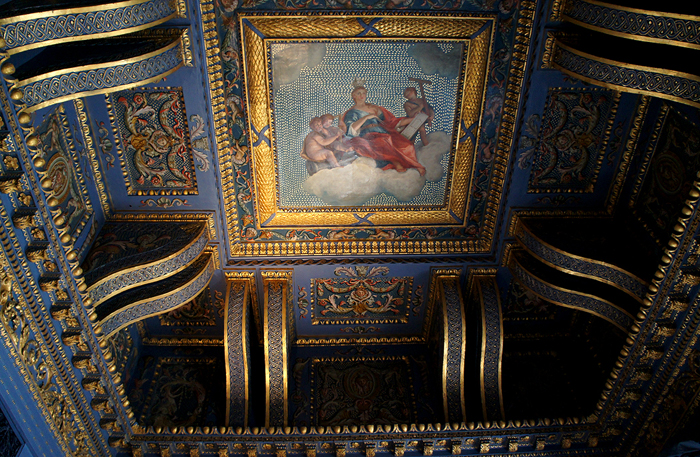
Chiswick House- ceiling of the blue velvet room, with an allegory of architecture

Chiswick House- ceiling of the blue velvet room, with an allegory of architecture

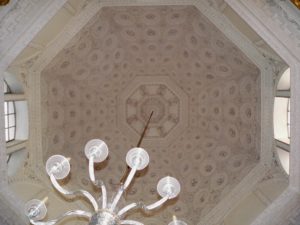
The ceiling of the saloon or ‘tribunal’ at Chiswick House

The ceiling of the saloon or ‘tribunal’ at Chiswick House

It is also difficult to know where Burlington’s work ends and Kent’s begins, but suffice to say, they both brought back to England a Palladianism that sought to capture an Italianate style of decoration, both without and within, that was a marked departure from the Baroque style then in vogue. Sometimes, though, as at Chiswick House, Kent’s work can seem more than a little ponderous. With its intense colour and riot of decoration, the Blue Velvet Room is rendered nearly claustrophobic, with its ceiling an allegory of architecture, bespeaking an econcomium to Kent’s patron Lord Burlington. It is in scale though perhaps more appropriate to a very much larger space. The saloon or tribunal, as well, positioned as it is to be the main gathering place within Chiswick House, seems small and pokey, despite being well lit from above with the placement of ‘thermal’ windows. Nevertheless, coffering appears small and fussy, and visually less effective than that in the original vastness of the Pantheon the saloon sought to evoke.

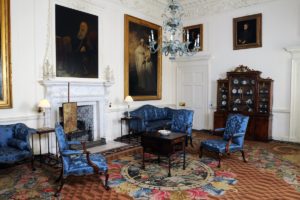
The drawing room, Dumfries House, with blue damask upholstery

The drawing room, Dumfries House, with blue damask upholstery

A quick sidebar, the use of a blue ground colour in the Blue Velvet Room, its pigment perhaps derived from turnsole, was a striking inclusion. As mentioned in my earlier blog, the exterior elevations of Lord Dumfries’ slightly later house was influenced by Burlington and Chiswick House. Although the interior of Dumfries House is rendered in a less antiquarian, more pedestrian rococo style, the damask covering of most of the soft furnishings including the pelmet and hangings of the bed of state are in the same, turnsole blue. It is further worth noting that Lord Dumfries was particularly insistent that the fabric of this colour be used.


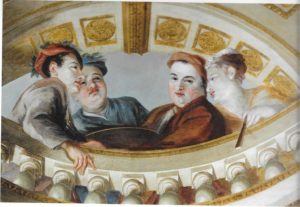
Portion of the Great Staircase, Kensington Palace, with William Kent in turban, by William Kent’

Portion of the Great Staircase, Kensington Palace, with William Kent in turban, by William Kent’

But as with Chiswick House generally, its interior design, including furnishings, function as a manifestation of a new style in architecture and design with a focus on an antiquity particularly Roman in character that achieved a striking resonance in the Britain of its day. While certainly the political influence of Lord Burlington was instrumental in obtaining appointments for William Kent, patronage of Burlington’s older protégé moved very quickly apace. Royal appointments included decorative commissions for George II at Kensington Palace  and perhaps most significant of all, an enormous amount of work for the first prime minister, Sir Robert Walpole.

The overarching figure of his day, Sir Robert Walpole, also of relatively humble birth, was extraordinarily useful to the court, bridging successfully as he did between Parliament and the king, easing the way for the German Hanoverian monarch and maintaining a long-lived, albeit fractious balance between Whigs and Tories.  With an era known even in its day as the Robinopolis, Walpole himself was aware of and sought to promote his political success with a visual language that found its most obvious vocabulary in the virtue of the republican Rome of antiquity, in which Kent, as it happened, was particularly conversant.

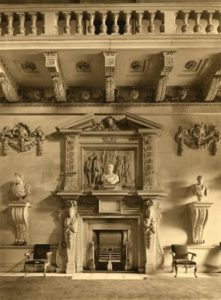
Stone Hall, Houghton, with bust of Sir Robert Walpole in the Roman manner above the fireplace

Stone Hall, Houghton, with bust of Sir Robert Walpole in the Roman manner above the fireplace

Walpole’s supreme expression of worldly and political success was his stately home, Houghton. While its Palladian exterior is the work of Burlington’s contemporary Colen Campbell, the interior design and decoration, and including the furniture, is wholly the work of Kent.

By contrast, though, Kent was also engaged in a variety of tasks both public and private that were at times considerably removed from his initial association not only with Lord Burlington, but also with a type Palladianism with ancient Roman overtones. More on this in a  later blog, but suffice to say, it is indicative of the character and affability of Kent that he was generally companionable and well liked. His appointments and commissions had arguably at least as much to do with Lady Burlington, as lady of the bedchamber to Queen Caroline, as to her husband. Lady Burlington’s surviving correspondence are full of endearments directed at Kent, referring to him variously as her dear little ‘signor’ and ‘Kentino’.  Whatever the relationship between Kent and Lord Burlington, it did not seem to interfere with the regard in which Lady Burlington held the man, who, along with her husband, spent his entire life in her household.

Pundits since the time of and including Horace Walpole have tried to impart a political message contained within sometimes abstruse symbolism and motifs in the work of Kent. What seems more obvious, given the variety of styles employed and political persuasions of those for whom Kent worked, he was in his day, to put not too fine a point on it, fashionable. It seems that fashion and the freemasonry of the rich and aristocratic did then, as now, override political divisions. Indeed, Kent himself had the final word on the subject, writing in his own idiosyncratic fashion that ‘ as Politicke are not my genius, it diverts me much now at night to look & read of these fine remaines of Antiquety.’

For reference:

The last two decades have seen much written to reexamine the life and work of Kent who’s remained by and large in the shadow of his most long-lived patron, Richard Boyle, 3rd Earl of Burlington. The exhibition staged at the Bard Graduate Center in New York and at the Victoria and Albert Museum in London entitled ‘William Kent: Designing Georgian Britain’ was an exhaustive examination of the life and work of Kent. The catalog and essays accompanying the exhibition, edited by Susan Weber, are a tour de force and do much to elucidate and rehabilitate the reputation Kent enjoyed in his lifetime.

Susan Weber, ed., William Kent: Designing Georgian Britain, Yale University Press, 2013


fpo-logoFor those of my gentle readers who live in the San Joaquin Valley of central California, if you didn’t attend yesterday’s Fresno Philharmonic concert, all I can say is, you’ve missed it. Under the baton of guest conductor and music director candidate Sameer Patel, it was a masterful performance, and a delight from beginning to end. With Maestro Patel the first of the candidates to appear through this concert season, the consensus amongst the cognoscenti is, he’s set the bar very, very high for those who come after him. Well, done, Maestro Patel and I mean this in the best performing tradition, break a leg.

Maestro Patel

Maestro Patel

As a man of a certain age, but not so old I don’t enjoy an evening out and appreciate, as it were, the afterglow perhaps as much as the act itself, it is a melancholy denouement, following an extraordinary sensual experience, to find that our alternative yesterday following the concert was only to get into the car and drive home. As it happened, turning on the TV on our return, I was pleased to find the Whit Stillman film ‘The Last Days of Disco’ on cable, and I was able, vicariously, to enjoy the characters’ afters, wandering from clubs to bars to late night coffee shops, but then sadly reminded of the dearth of such places locally. It was not always so.

Downtown Fresno, which used to be replete with watering holes and places for the hanging of out, is now bereft of them. Where are the French Café, the Pleasanton, Corbett’s, Dee’s and even more recently, Wall Street West, when we need them? Or, at least, when I need them? Mind you, most of these are of distant memory, even for a superannuated soul like me, but what of The Tower House or The Daily Planet? What I seek, frankly, is a smartly peopled, dark-ish bar where one might sample some healing waters, and then, perhaps, have a light-ish meal, nothing to interfere with the beverages, mind, but just a little something.

So, my choices are geographically limited to venues very near to Fig Garden Village or beyond, so once there, the glow has worn off and I might as well go home- which is what I did.

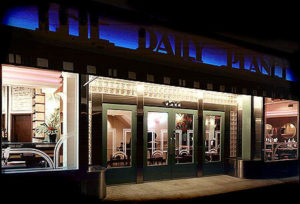
The Daily Planet, now only of blessed memory

The Daily Planet, now only of blessed memory

Of course, that the orchestra concerts are now in the middle of the afternoon on a Sunday doesn’t precisely help matters, with possible afterglow candidates, limited though they are, shuttered. What I’ve written so far makes me seem not much more- no, precisely no more- than a philistine looking for a good evening out. Philistinism, in this regard, is something I will happily admit to, and in their private moments, a majority of my readers would, if pressed but slightly, admit to being of the same mind.

Believing that progress is wrought by putting one foot ahead of another, the extraordinary concert performance yesterday might be the first step in establishing an expansion of the concert series in season’s to come to include, as in day’s past, evening concerts- to follow, we can hope, with the opportunity for conviviality and blessed refreshment at a few smart watering holes.


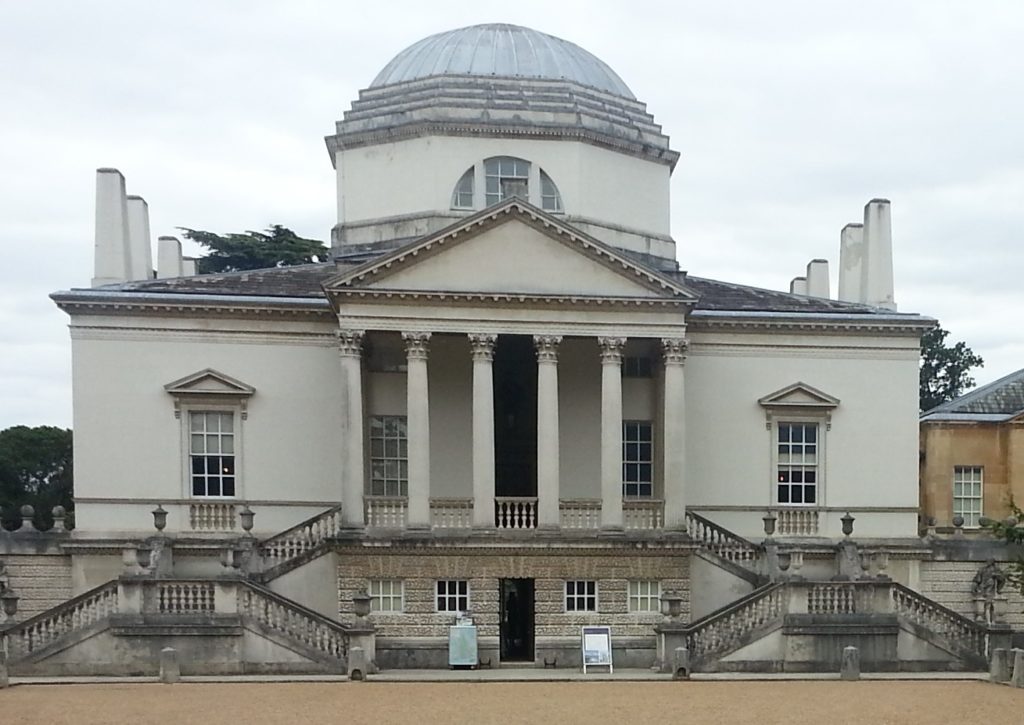
That since I’ve known of it Chiswick House has always served as an exemplar of classical architecture is hardly a unique opinion, but in this opinion I newly find myself in the company of the Adam brothers and the 5th Earl of Dumfries.

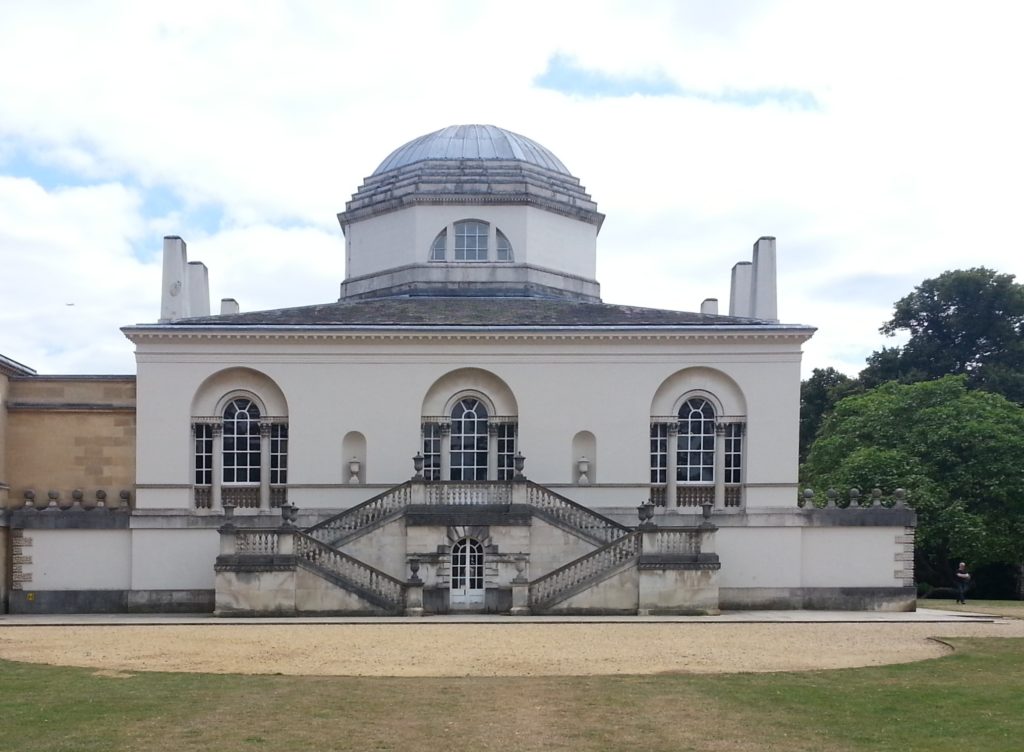
chiswick-serliana

Chiswick House west front- Pantheonic dome surmounting ‘Diocletian’ and ‘Serliana’windows’.

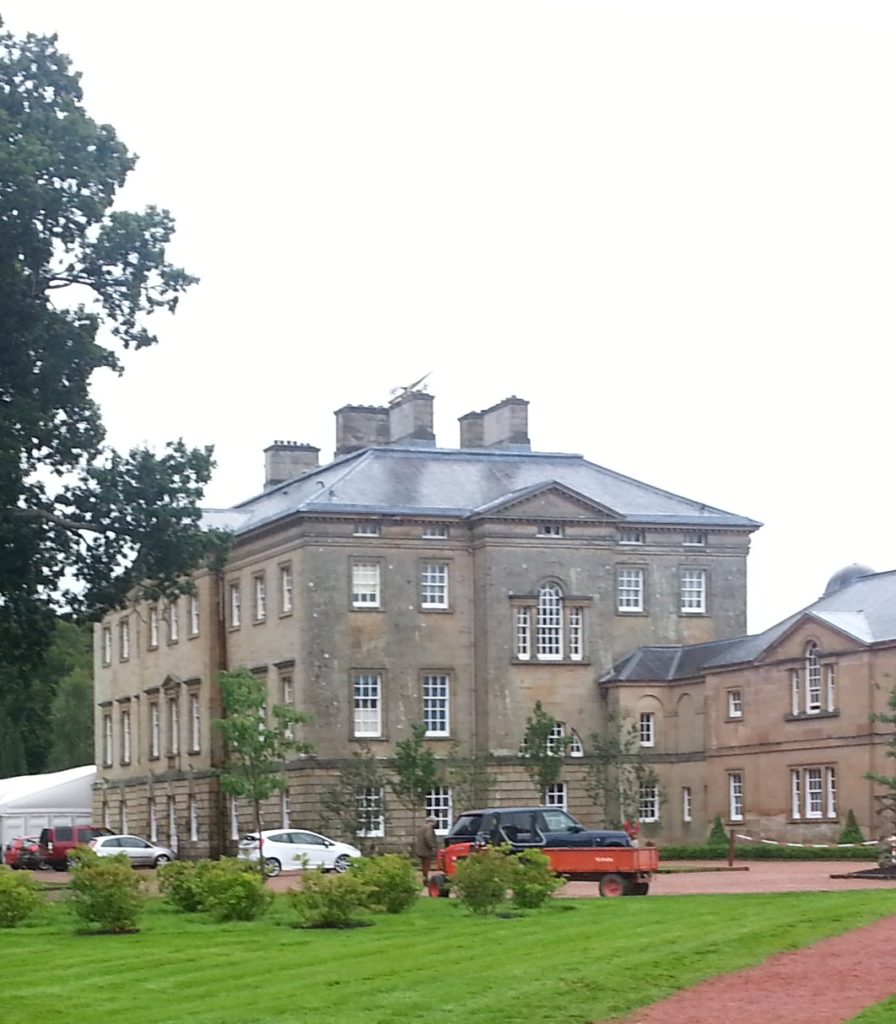
It is always a treat to visit Chiswick House and I’ve lost count of the numbers of times it’s been over the years, as a visitor, as a student, and as a professor of art history. But this last time, in a happy synchronism, it was shortly thereafter followed by a visit to Dumfries House. We visited both Chiswick House and Dumfries House a couple of weeks ago and, while Dumfries is perhaps more well known for its link with the Adam family of architects, and noteworthy as perhaps the earliest work in which Robert Adam took a major hand, the visual language owes very much to the genius of the gentleman architect Lord Burlington, whose acolytes included most of his contemporaries, both aristos and architects.

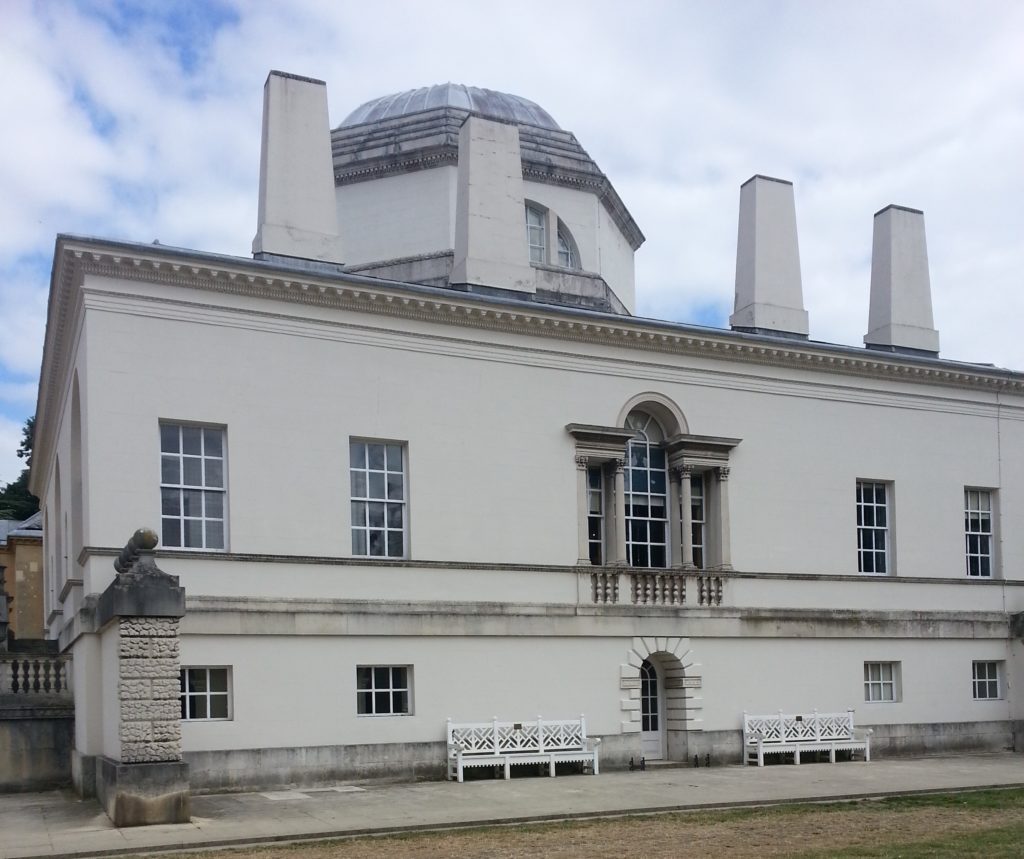
chiswick-house-north-front

Chiswick House- north front

With the design of Chiswick House, Lord Burlington sought to construct and give homage not just to Andrea Palladio, whose work he had seen in situ in Venice and the Veneto, but also to antiquity, Palladio’s contemporaries, and his then greatest English adherent, Inigo Jones. Still, Burlington’s work does contain some idiosyncratic touches, including a marked fondness for the tripartite window design popularized in the work of Serlio, and while known variously as a ‘Palladian’ or ‘Venetian’ window, it is most often, in homage to Serlio, called a serliana. With its use on the west front of Chiswick House, a serliana marks the primary decorative element, while the north front uses three, placed within balustrades and relieving arches, to establish a symmetrical rhythm.

Although the serliana would have been unknown in antiquity, there exists a sufficient nod to the likes of Vitruvius in the Pantheon inspired dome above a window design taken from the Baths of Diocletian, and known as either a Diocletian or ‘thermal’ window. The chimney stacks were formed in the manner of obelisks, a Roman trophy taken from an Egypt conquered in antiquity, and re-erected by Sixtus V to mark significant locations and viewpoints in the midst of the thoroughfares of late Renaissance Rome. Clearly, study enhanced with not one but two Grand Tours was not wasted on Lord Burlington.

chiswick-house-portico

Corinthian columns in the Chiswick House portico.

While Chiswick House is most commonly assumed to derive from Palladio’s Villa Rotunda, itself derived from the Pantheon, it is hardly a literal quotation and has always seemed to me that, with the greater abundance of ornamentation, Burlington sought to provide more explicit visual references to classical antiquity than did his Venetian predecessor. The columns of the portico are of the Corinthian order, and copied from the Temple of Jupiter Stator in Rome. While a lot has been written over at least the last two millennia about the anthropomorphised personalities and uses of the different orders appropriate to those personalities, it is hard to doubt that Burlington knew everything written up to that time, and used the Corinthian order deliberately. While it has been said that visually the Corinthian was assumed to communicate an air of refinement Serlio had also written it was the appropriate order for churches, particularly those dedicated to the Virgin Mary. It is known that Burlington was a recusant Jacobite, devoted, in his private moments, to the Stuart cause. Perhaps it is not too fanciful to think his use of the Corinthian order is some subtle albeit coded nod to the Stuarts and the Church of Rome.

dumfries-house-east-front-detail

Dumfries House, east front, with serliana and thermal window.

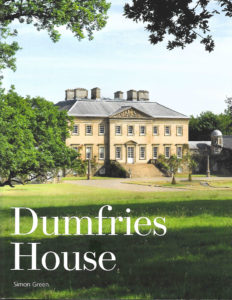
Where Lord Burlington handled classical and Renaissance elements to elegant and sophisticated effect, the translation to the seat of a Scottish nobleman was not quite so successful. Simon Green, in his guidebook to Dumfries House, cites correspondence between Lord Dumfries and another Scottish lord, the Earl of Hopetoun, wherein Hopetoun mentions how the Adam brothers had shown some of the drawings for the proposed house to Lord Burlington who, it seems, gave his approval. No question, in the second quarter of the 18th century, Burlington was one of the premier arbiters of taste and refinement amongst the aristocracy, and Chiswick House naturally functioned as a real manifestation of that taste and refinement.

dumfries-house-east-front-elevation

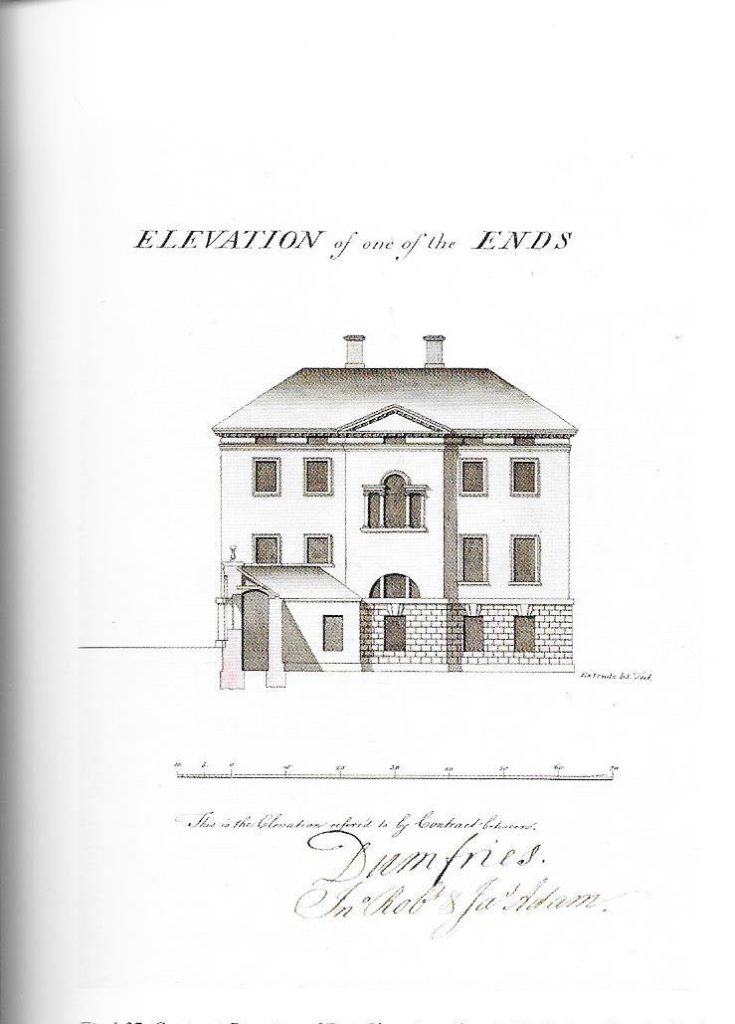
Elevation of the Ends of Dumfries House, signed by the Adam Brothers and Lord Dumfries.

However, in the inexperienced hands of the Adam brothers, the result is substantially less refined. In a view of the east end of Dumfries House, one sees a serliana  used to light the main staircase, and a thermal window placed beneath it to light a passage for the floor below. While the elements are recognizable, their placement and effect are visually dissonant. The arch of the thermal seems flat and heavy with its too close placement below the serliana and directly above the rustication of the ground floor creating thereby a discordant effect. Moreover, the use of both these elements, placed in a central, projecting bay, emphasizes this clumsiness made even clumsier by a lack of a symmetrical and stylistic relationship between the windows of the two bays on either side. The more careful and appropriate scale, placement and rhythm Burlington achieved with a serliana and a thermal was a subtlety that was perhaps beyond the ken of John, Robert and James Adam. Lord Dumfries was no more enlightened, and was doubtless of the belief that use of classical elements, no matter how ineptly wrought, would nevertheless signal his sophistication in matters of design. In this, architect and patron were alike, witness that all of them signed off on the elevation which drawing in itself is of discordant effect. Could something of this sort, as correspondence between Dumfries and Hopetoun implies, been shown to and received the approbation of Lord Burlington? Surprising if it were.

p1010333-crp-dist-dk-s1w760s0-1-q50

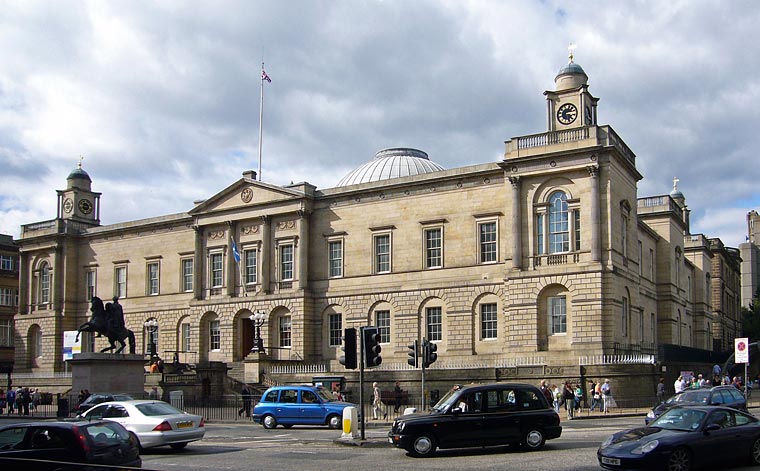
Register House, the serliana well placed.

With all that, Dumfries House and the work of the Adam brothers are significant in that they mark what was the first Scottish residence to display these elements, and also in that it is yet more proof, if any were needed, of the overarching influence of Lord Burlington in matters of design that pervaded Great Britain, even if that influence may not have been shall we say favorably executed. Something to note, perhaps gratuitously, the Adam brothers, and most notably Robert Adam, ultimately became the deserved torch bearers for classicism, with Robert Adam the virtual inventor of a neo-classicism espoused visually to extraordinary effect. Performing something of the role as apologist for Robert Adam, Simon Green does acknowledge the facility and effect with which the mature Adam employed the serliana, citing the Register House in Edinburgh.

For reference, the following are both accessible and worthwhile:

Simon Green, Dumfries House, 2014- the official guide to Dumfries House, with excellent, new scholarship derived from archival sources

Chiswick House, English Heritage. The edition written by Richard Hewlings or the edition updated by Roger White, are complete and succinct. Both Hewlings and White are redoubtable architectural historians closely connected to The Georgian Group, the licensed consultancy in England on the built environment between 1714 and 1837.


It is sad to read about the vicissitudes of the Keno Brothers, characterized by a friend and ‘Antiques Roadshow’ stalwart as ‘the rockstars of the series.’ No question, that they are twins, relatively young, not precisely handsome but certainly distinctive in appearance, and, as the New York Times article detailing their problems has it, ‘telegenic’, they have over the years functioned to bring an interest in and attention to a trade that has been suffering for the lack of it. They are possessed of an intensely energetic delivery that while engaging, is at times so much of a muchness that it makes one wonder whether they have had too much coffee, or having had too much must needs make haste for the gent’s.

Still, what’s been said about them in the press is at the very least bad news for a trade that is often seen to operate in an environment of shadow and prolixity akin to the arcana that is the stock in trade of many of its dealers. The two have debts from unpaid auction invoices in the high six figures, and worse yet, it appears they colluded to run up the hammer prices on a number of the pieces knocked down to them. In the latter, they claim they had miscommunicated, that one brother was bidding online while the other was bidding by phone, and that neither was aware of the actions of the other. Really? Pull the other one- it has bells on it. In the former case, the unpaid invoices result from cash flow difficulties, with the clients who had commissioned the brothers to make these purchases on their behalf then reneging. With the prices for these pieces ostensibly run up by them, I shouldn’t wonder.

While this sort of high profile shenanigan does no good for an industry already on the hardest of hard times, I must say that this is hardly the first I’ve ever heard of shall we say missteps amongst old lags on the Roadshow. Witness, for instance, the fairly recent case of one of the valuers who waxed eloquently about a piece of crockery he thought was a treasure of mid 19th century Americana. Egg on the face quickly followed, when it was discovered soon thereafter the piece was a high school art project of such recent vintage that it was hardly dry.

For those of you who are regular watchers, you might be surprised to find that, with locations changing each week, and nearly all of the faces familiar from week to week, the experts pay all their own expenses- travel, lodging, eats- and are compensated at a rate of zero by the producers of the series. For those experts employed by an auction house- and this constitutes probably half or perhaps more- an appearance can engender interest and result in perhaps a consignment, and presumably this is part of the motivation for some of the private dealers, as well. For myself, this kind of public involvement has not much appeal, as we already get plenty of calls, asking for valuations of items gratis, and offers to sell us something that is totally unlike anything we would ever have in inventory and or could ever sell.

allankatzEven across fields of collecting, the trade in art and antiques is a small fraternity, so inevitably, our paths would have crossed, sometimes almost daily, with a number of those on TV. A few, like Allan Katz, are possessed of the highest degree of knowledge and probity. Whatever Allan says, one could take to the bank. We do, though, know some others who  are sadly greater in number with whom we have had, shall we say, a less than savory experience. A particular paintings expert, for example, is someone about whom I have already written, having formerly been our near neighbor. His neighborly and collegial mien manifested itself by badmouthing a painting we had for sale, expressing the opinion that it was not the real thing when in fact its provenance was clearly documented and contained within the artist’s catalogue raisonné.