The major news flap this week surrounding the Facebook whistle blower puts me in mind of our own experiences with social media which, it appears, forms a significant portion of what is now described in common parlance as big tech. As I am writing this post on my Dell desk top utilizing Word for Windows, for me, big tech means something else. Social media should more appropriately be termed ‘noisy tech.’

But no question, whether big or just noisy, or noisome, social media has remade all of us for the convenience of some and the detriment of many. So many, apparently, and in such an insidious way and with such dire results, those who seek to regulate this portion of big tech liken it to the big tobacco of an earlier day. When I had initially heard this comparison, it seemed overstated, but then the more I’ve heard and read, the more appropriate the comparison is borne out, even by social media’s own internal reckoning. Similarly, big tobacco before being called publicly to account knew in detailed terms the horrific effects its products were having on users. Despite for years posting the required warning labels on its tobacco products, companies have never to my knowledge really acknowledged any real responsibility. Likewise, the major social media platforms, while saying publicly they are working to ferret out problems have never acknowledged their own complicity, or culpability.

Still, as with big tobacco, social media companies know and can profitably rely upon the knowledge that there are millions, or more probably billions, of the weak minded who will intentionally put themselves in harm’s way.

As well as the technology employed to pen this post, all of my gentle readers will have accessed it through some arm of big tech, most likely through a search engine, so what I’ve written above might seem to make me out a hypocrite. I’d like to think that, as I do not smoke, I can also, possessed of moderately good judgment, with reasonable safety employ big tech in a productive way. But I have to be honest- though I can’t say that I have been the victim of body shaming, my own shall we say discreet use of social media has been influenced by some negative incidents.

Years ago, when we established our own page on Facebook as what appeared the coming thing, I sought to expand our commercial reach through attracting what were then and are now termed ‘friends’. Mind you, when I use the word, it means something different than the tangential point of commonality that is meant when it is employed in social media. Can you imagine, though, clicking on a request to become someone’s tangential point of commonality? So I suppose, in this context, ‘friend’ becomes useful shorthand, though for me it has, sad to say, become a neologism.

Still, we have attracted so many friends to our social media platforms we are now informed by several platforms- through messages sent on their own platforms, of course- that Chappell & McCullar are now, wait for it, ‘influencers.’ As this is something new to me, you’ll pardon this question posed in a contemporary idiom- is this a thing? Apparently so, and as I have seen people so designated on social media, it is also apparently a vocation, albeit an ephemeral one.

I should further say it is a poorly paid one. Frankly, our own social media posts have been nakedly venal, almost entirely for the purpose of supporting our core antiques business. This naturally begs the question, has it helped? And as with any other promotion we’ve ever employed, the best I can answer is, perhaps, but as with any other promotion, there has been a cost.

No, no revelations here about body shaming, but several weeks ago, in response to a blog post on social media, one of my ‘friends’ took me to task, online of course, with her terse criticisms employing terms like ‘wanker’ and ‘left-wing asshole’ with her tirade concluding with a demand that I, wait for it, ‘unfriend’ her. ‘Unfriend’ is also a thing. By the way, I had never otherwise had any interaction of any sort with this erstwhile friend, and the why it was that when reading my posts she did not take the first step and seek to unfriend me is a mystery, beyond the fact that, had she done so, she would be denied the opportunity to call me a wanker.

Hopefully my gentle readers have found that my social media posts are not primarily a virtual cudgel for online invective, and as I use it mostly to promote our business perhaps it is similarly useful to some of our colleagues. A trade association of which we’re a member held an online seminar about how to use social media effectively, with one of the key takeaways that, when one’s page is ‘friended’ or ‘followed’, or ‘liked’, one must reciprocate, friending, following, or liking in kind. I pity those of my innocent colleagues who took on this suggestion wholesale, as they’ve doubtless found many of their ‘friends’ to be a bewildering number of porno websites. For those who have attempted to use paid promotion to further their social media presence, many are frightened to find sometimes successful attempts to hack their credit card accounts perpetrated by friends let in to personal information by the virtual front door. A sidebar- it astounds me that so many of my colleagues post online, real-time events including where they are on holiday, and then shocked to find upon returning their home has been broken into and ransacked. When I see these fun holiday posts, it is all I can do to refrain from commenting ‘Is the front door key still under the mat?’

No question, social media has a lot to answer for, but, too, just like the putz who continues to smoke, or like most other things in life, come to that, a level of personal responsibility must be undertaken. No, no one forced me to be online, and no, no one forced me to smoke that cigarette, no matter what the blandishments. A final sidebar- we do have a couple of clients who are at the most senior management level of big tech. Their purchases of our traditional material, for those of you interested to know, were made not virtually or in response to a social media post, but in the traditional way, by coming in through the actual front door and shopping in person.
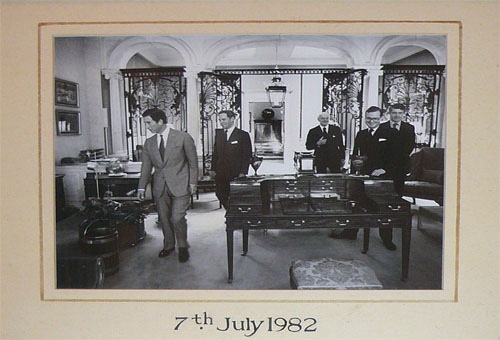
The Prince of Wales visits Mallett

The Antiques Trade Gazette is reporting that troubled coin and stamp dealer Stanley Gibbons Group, who retained the Mallett brand in the US having sold if off in the UK in 2018, is nevertheless moving this once vaunted name into Chapter 11 bankruptcy. The company had through its Mallett subsidiary retained the lease on its former shop premises on Madison Avenue following its closure, subletting to luxury fashion brand Stella McCartney.

Stella McCartney, however, stopped paying rent to Mallett in April of last year, and consequently, Mallett was unable to pay the underlying property owner. According to the ATG, the property owner was unwilling to extend payment terms on the rental arrears and consequently, Mallett had no choice but to file bankruptcy. The Chapter 11 filing, allowing for a reorganization will doubtless convert to the more final Chapter 7 involving a liquidation of all assets to satisfy creditors, the largest of which must be its New York landlord.

A sad and ultimately final end to a vaunted company that began in 1865 and was for over a century at the pinnacle of success within the trade. Moribund in England, its Bond Street leasehold has long since been taken over by Fendi, one of the many luxury brands owned by French conglomerate LVMH.

What I find interesting in the present chapter of the saga is somewhat less about Mallett than it is how so early on in the pandemic luxury fashion retailer Stella McCartney stopped paying rent on its Madison Avenue premises- little more, if one can recall recent events, than a month from the declaration of the COVID pandemic. One wonders whether this ostensibly well capitalized luxury brand was either brazenly opportunistic in taking financial advantage of a global catastrophe, or so thinly capitalized that an immediate drop off in business resulted in stopping payment of rent out of an immediate economic necessity. I suppose looking at it from the latter perspective, it is perversely democratizing when someone as elite as the daughter of Sir Paul McCartney shares something very much in common with the now-defunct shave ice vendor formerly around the corner from my home in Hawaii.

And then the question begs how fares the Fendi boutique on Bond Street, Mallett’s former flagship location. I’ve not heard specific rumblings, but then, the major landowners in the West End, which includes the Queen herself and the Duke of Westminster, are renowned for their deep pockets. But then, neither are they known for unending patience when it comes to money matters. As I’ve always maintained, no matter how wealthy you are, there always has to be a payday.

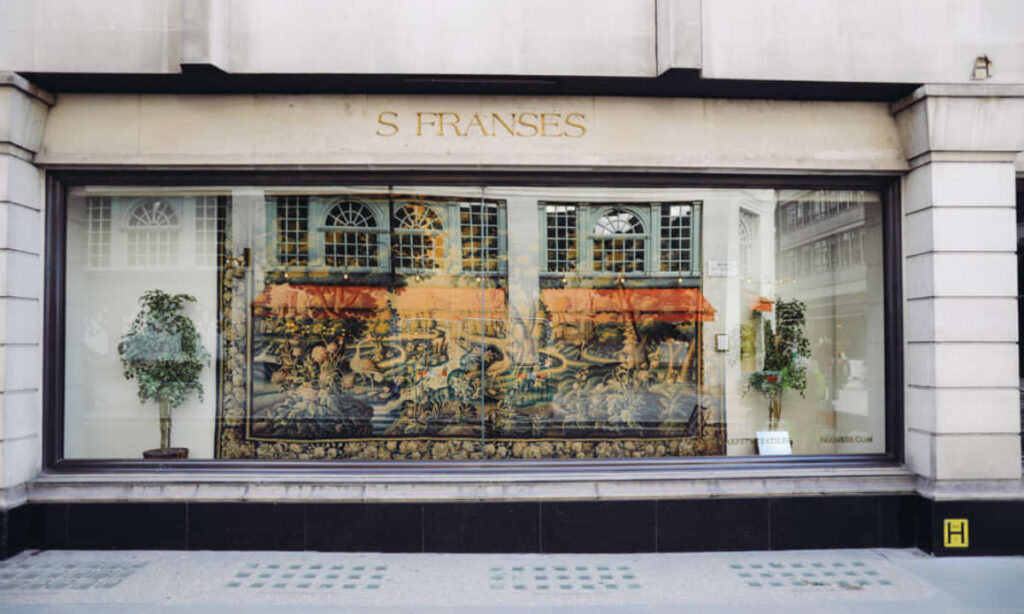
S Franses, Jermyn St, London

It is as they say an ill wind that doesn’t blow somebody some good, and while I can’t honestly say I’ve shed too many tears for the international luxury retailers who’ve in the last 20 years nearly obliterated the existence of independent shops in the better venues, it might be a sign of hope for those few who remain. It is certainly my especial hope that the retail trade in art and antiques, virtually swept away the result of rents that became ruinous, might find the economic tide turning in their favor. Several weeks ago, also reported in the ATG, longtime Jermyn Street dealer S Franses was able to prevail over the predations of his landlord, and promises to stay put for years to come. Hopefully this harkens better days by way of cheaper rents ahead for those of us who survive in a business, albeit a beleaguered one, we love.


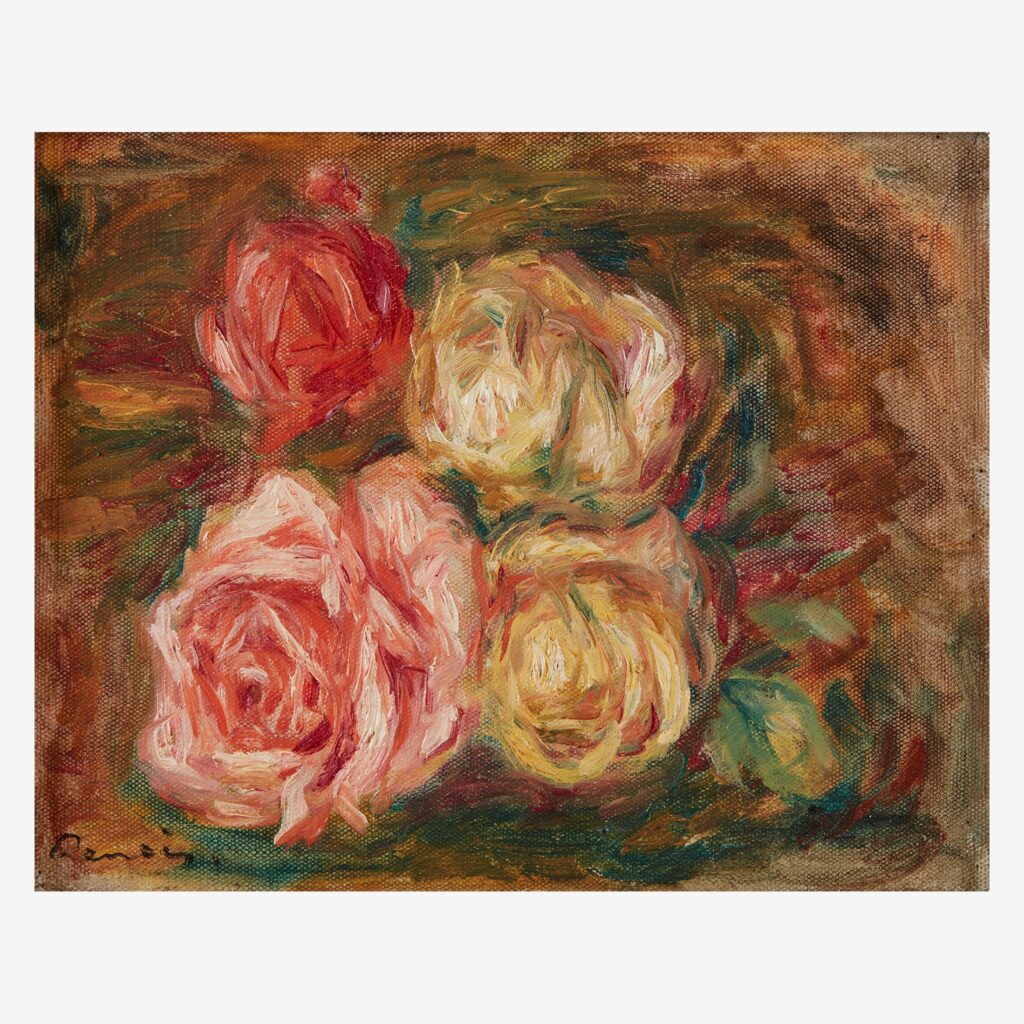
Pierre-Auguste Renoir, ex collection Virginia Museum of Fine Arts, image courtesy Freeman’s

We do from time to time welcome student groups from the local university, and one student in one such group asked upon visiting whether any of the items in our inventory were, in her words, ‘museum pieces.’ My reply was ‘All of them or none of them.’ Momentarily glib, I’ll admit, it did serve to beg discussion, with museum culture, as my gentle readers will know, being one of my favorite topics. I happily explained that what ends up in a museum does so because someone made the decision to put it there, and that ‘museum piece’ by which was meant ‘museum quality’ is the result of an entirely subjective judgment, and given the masses of items being deaccessioned, hardly an enduring one.

Let’s back up to the point of beginning, the why of museum’s acquisitions in the first place. Certainly in the case of survey art museums, a huge quantity of material is on offer- gratis. As most museums now devote a significant percentage of their exhibition space to living artists, it is typical for an artist exhibiting to donate one or more, or many, of the items on exhibit to the museum that fielded it. And once offered, it is the job of the museum’s accessions committee, headed by its chief curator and usually composed of several museum trustees, to determine whether or not to accept the items offered. Too often, too many pieces are accepted the result of several factors that are endemic to most museums. In the first place, very few museums have a clearly established policy about accepting artwork, and certainly in this day and age where museums are struggling and are grappling with what it takes to ensure their very survival, it is easier to just accept an artwork than to risk hurt feelings and subsequent claims that, in not accepting an artwork, the museum is somehow at least indifferent, or even hostile, to a portion of its constituency.

In palmier days, when survival was less concerning, one might think accessions could be more rigidly controlled, with its constituencies more established and less in a state of flux. If you thought that, you’d be wrong. The survey art museums have always been about money, and the constituency that mattered almost solely was the great freemasonry of the rich. In the United States, if survey art museums in the bigger cities have a European feel to them, that is because in the 19th and early 20th centuries, US museums consciously sought to ape their European predecessors, aided by the likes of Lord Duveen who found eager customers in, to name two, Andrew Mellon and Arabella Huntington who fervently believed that high culture in America had to be imported from Europe if it were to exist at all. With all that, for every Gainsborough ‘Blue Boy’ there were bales of sort of looks like but not really the same that went on the walls, with museums built at a faster rate than there were artworks of quality to display in them.

So, what have museums got? Masses of artworks and other objects acquired under a variety of different rationale, none of which really conform to any precise rubric. And once acquired, for most of them, their fate is to languish in some storage facility in the basement. I wrote ‘languish’ when in very many cases it would be more accurate to say ‘molder’ as even under the best storage conditions, many items, and particularly paintings, gradually disintegrate. I am reminded of the lament of a museum curator who told me how, in a few short years, a proud signature of a famous artist, scumbled atop the design layer of one his best works, gradually flaked off. Take it from me, paintings, period furniture, indeed most works of fine and decorative arts are dynamic in their materials. Oil paintings typically require significant restoration, even if held and exhibited in optimal surroundings, at least once a century. That might seem infrequent, but as a reminder, the major museums in New York, Los Angeles, Kansas City, Omaha, and San Francisco and all points in between, and their corpus of collections, are well into their second centuries.

As most of my readers will remember, and flying in the face of the horror and castigation expressed by the Association of Art Museum Directors, my answer to any museum grappling with deaccession is a simple one- sell. There is nothing to be ashamed about, and given that most museums, perhaps all of them, have masses of material that will never otherwise emerge from storage in the bowels of the institution, why ever not? As I’ve written so often before, and as recently as my last blog, in these times survival is the name of the game. We’ve seen over the last couple of years lots of face-saving maneuvers employed to justify deaccessioning, with a favorite at the moment attempts to achieve racial equity in balancing collections- selling off artworks to fund acquisition of works produced by those of, say, gender and ethnicities that more closely match a museum’s changed constituencies. Laudable, but newly acquired artwork is just as expensive to maintain as what’s already in the basement.

And what’s already in the basement might be a bit easier to turn into the cash most museums now find they have in fearfully short supply. In reading the monthly newsletter of an East Coast auction house who maintains an active department specializing in deaccessions- and most auction houses now have them- I was reminded of the sale earlier this year of a work by Renoir, deaccessioned by the Virginia Museum of Fine Arts. Important to note- until it was consigned to auction, this work by one of the best known masters of impressionism with a long ago published catalogue raisonne was unknown.

Fat lot of good a work by Renoir was doing in the basement, unseen, unloved, and clearly unknown and naturally begs the question how much else there is enjoying an equally ignoble fate- and deserves to see the light of day?


My early morning ritual begins with a long walk on the treadmill at the gym, the bank of which are well supplied with large screen TV’s. As a consequence, I was able to watch a segment on Fox News entitled ‘Indoctrination or Education?’, the point of which, in simple terms, was to dispute the necessity for any consideration of critical race theory in public education in the US. This being Fox, ‘dispute’ understates the tenor of the discussion with ‘decry’ more appropriate.  

My gentle readers won’t be surprised to find that I am an infrequent viewer of Fox News, which most pundits will allow has less to do with news than it does an aggregate of opinionated talking heads, which talk consists of shallow, ill formed criticism of anything espoused by those in government or the media of a more, shall we say, intellectually progressive bent. Fox’s editorial policy would define ‘intellectually progressive’ as ‘socialism’. And we all know how abominable those long standing socialist programs are- Medicare and Social Security, for instance. Anathema. 

I digress.  

A consideration of critical race theory then begs question about the nature of public education, and immediately puts me in mind of teacher training. No one living remembers that teacher training colleges were in the 19th and early 20th centuries called ‘normal schools’ by which was meant training in the ability to teach a normalized curriculum of reading, writing and arithmetic. In this, I’d venture to say the United States outstripped the rest of the world in providing a free public education standardized such that all its citizens could communicate with each other linguistically and numerically. Certainly for a nation as geographically disparate, this was an essential feature that ensured social cohesion.  

In my own youth, the public schools that I attended did a great job in promoting the basic curricula, but I can’t honestly say that critical thinking was very much in evidence. In my own hometown, despite a large population of Americans of Japanese descent, I never heard a word about Japanese internment during World War Two until I was well along in high school. And, coincident with that, there was no significant discussion about Jim Crow/Plessy v Ferguson despite the fact that at the time, the civil rights movement was roiling a large part of the country. The only doctrinal issue I can remember from my public schooling was that the American system of government was good- as opposed to communism, the great of evil of my day, which was bad. I remember vividly in a social studies textbook of perhaps my own grade 8, with a photo of a white American family en famille in what would be taken as a comfortably typical home, illustrative of Americanism. The opposing photo was of a group of goose-stepping soldiers marching in the Kremlin. The simplistic, or simpleminded, text beneath these paired photos told how America was a place of freedom and plenty, and Communists’ sole raison d’etre was world domination.   

Ignoring social issues and a dearth of critical thinking within the curriculum makes it of course easier not so much for teachers to teach, but for boards of education to have trouble-free tenures. But then, the remit of all boards of education is governance consistent with the social and intellectual standards of those they represent. A conservative community yields a socially conservative board- a more progressive community yields, well, a slightly less conservative board.  

And ultimately, it is an inherent conservatism in public school education that makes the incorporation of any sort of social change within its established curriculum so difficult to accomplish. And, too, the life of the teacher and the five, ten, or 50 year old textbook renders canonical the thinking of an earlier generation. What might be considered as the socializing effect of a public school education is in reality, a normalizing indoctrination of thoughts and opinions most common at the time a teacher received their credential, or when a textbook was written.  

I have to say, at long last we are generally having discussions that include previously ignored and tabooed subjects related to race, gender, sexual orientation- and sex generally- and economic inequality. Discussions, mind you, of which critical race theory is amongst them. But then, important critical considerations previously ignored must start someplace, and I repeat, at long last. Let’s take another look in our own mind’s eye at the social studies textbook picture of Americanism. Bear in mind that what you don’t see- gender, race, and income inequality- was certainly present, but using the photo as our exemplar, safely out of view and what might have been in view, papered over.  

‘Indoctrination’ as the Fox News commentator would have it is absolute balderdash. The long standing, habitual failure to acknowledge long present and shall I say critical issues that begged for the likes of critical race theory has eaten away at the social cohesion public education was designed to promote. Fox News needs only to pay attention to its own reporting to know the truth of this.  


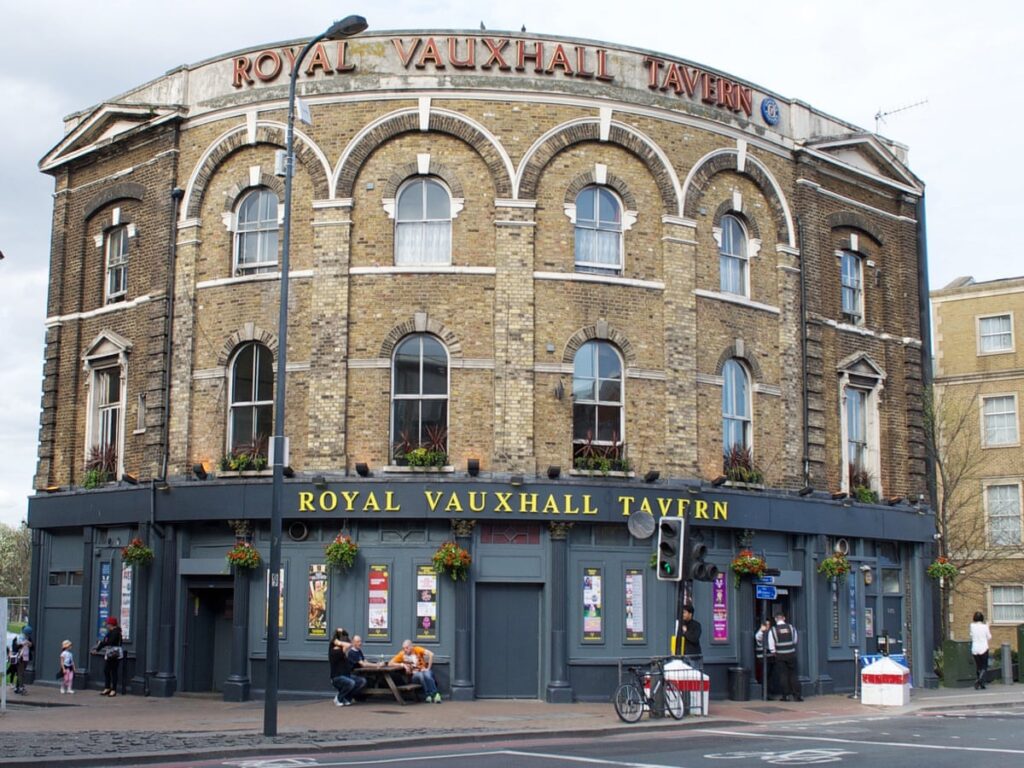
The Royal Vauxhall Tavern- a safe space in south London

This morning I watched a Zoom presentation hosted by the University College London New York alumni club, and featuring a presentation by UCL Professor Ben Campkin. The focus was largely on the loss of ‘safe’ spaces for the LGBT community through intensive urban redevelopment and gentrification. What this meant for Professor Campkin was, largely, a loss of gay pubs in greater London. He pointed to, for example, the development of Crossrail and its impact in central London with the displacement of several gay venues, arguing that the change in the governance of London, from the liberality of Ken Livingstone in the early 2000’s to the more recent conservatism of Boris Johnson functioned to deprive the LGBT community of established safe spaces.

Well, maybe.

As someone who as a superannuated UCL student living in London in the 1990’s and early 2000’s, I can say based on my own lived experience that gay pubs were, in the main, no better than any other gay bars anywhere else in the world. They were and are, not to put too fine a euphemistic point on it, toilets. A not so subtle feature should be borne in mind that, in providing so-called safe spaces, landlords effectively victimize the LGBT community, realizing that that community is a captive market that will tolerate almost anything in exchange for a venue in which they can be themselves. There was a time, and the iconic Stonewall Bar is a good example, where many gay bars certainly in New York and San Francisco were actually owned by organized crime who were experienced at victimizing marginalized communities, and who also knew, to keep the LGBT community coming back, that they could pay off the cops- something about which they were also expert- to prevent police raids.

Mind you, Keith McCullar and I met in a gay bar, 41 years ago. At the time, I thought less about a safe space than I did about cruising, and if I wanted a drink, could always go to, shall we say, a more pleasant venue. Neither Keith or I were specifically looking for a life partner, but we found each other, and as a consequence, yet maintain a nostalgic fondness for the institution of the gay bar. ‘Safe space’, perhaps, but any gay man who denies that a bar served primarily as a place to pick up a trick has a loose grasp on the truth.

Frankly, I am not so sure that the gay bar as an institution hasn’t been dying a natural death. Grindr and other such apps that serve as a virtual safe space make the bricks and mortar space redundant. The other thing, and this will engender the ire of social activists everywhere, the LGBT community is more broadly accepted- mind you, with a long way to go, but enough forward progress that as a consequence can feel measurably more safe in taking their custom to non-LGBT venues. Moving from London to San Francisco after a long absence, I asked a gay friend in the city about any gay bars that might serve as a ‘local’ for Keith and me. He sort of curled his lip and said ‘When we go out, we usually go to a decent place.’

Yes, well- we never did find a ‘local’ although we regularly socialize in public venues with gay friends just about anywhere. Of course, our travels and habitations are in cities of a more liberal bent, and it may not be the same in Nether Wallop.

Still, I would argue that a gay bar is a cultural anachronism. Particularly in the context of a gay man in London, the prevalence of cottaging has declined with the liberality that has allowed the opening of the safer spaces of gay saunas. In today’s lecture, I didn’t hear Professor Campkin arguing for the preservation of cottages. Let’s look on gay bars and the necessity for them as safe spaces as emblematic of the bad old days where such venues were not just integral, but essential to the LGBT community. I don’t want to hide in the closet or in a gay bar, which in my view, is the real world equivalent. It seems to me the more compelling effort should be to continue to be out, to socialize the wider world toward ever increasing comfortability and acceptance of the LGBT community to which I am proud to belong.