
That since I’ve known of it Chiswick House has always served as an exemplar of classical architecture is hardly a unique opinion, but in this opinion I newly find myself in the company of the Adam brothers and the 5th Earl of Dumfries.
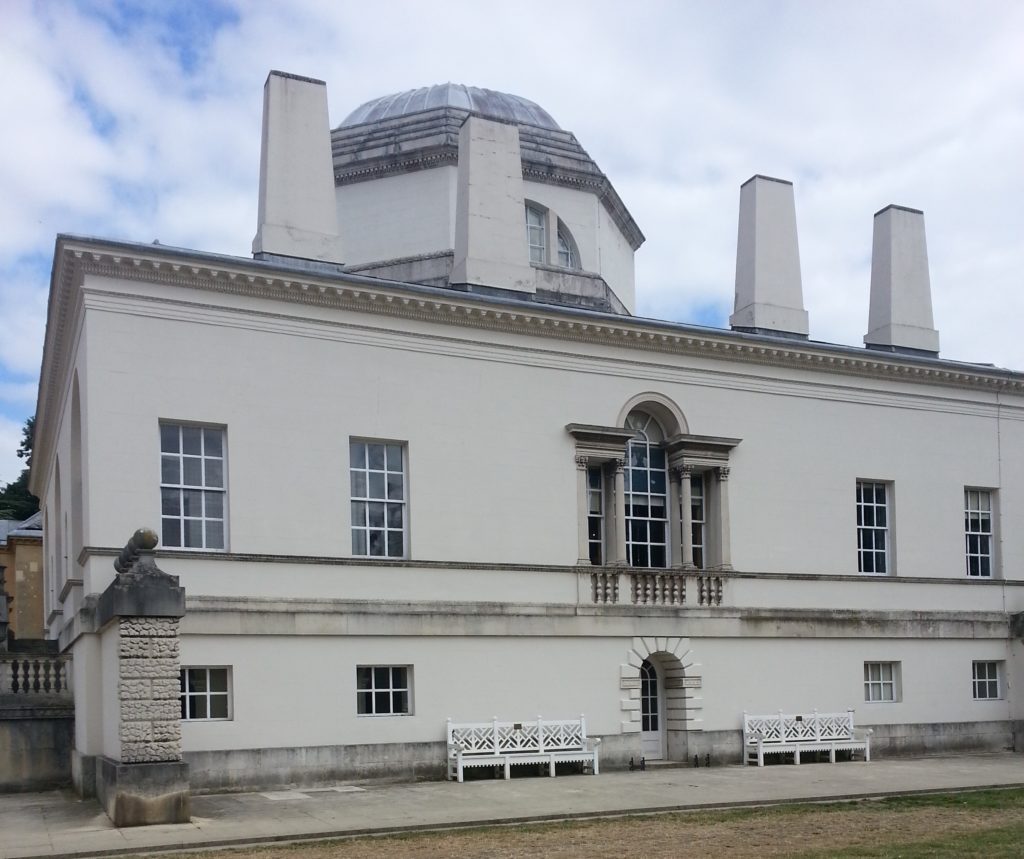
chiswick-serliana

Chiswick House west front- Pantheonic dome surmounting ‘Diocletian’ and ‘Serliana’windows’.

It is always a treat to visit Chiswick House and I’ve lost count of the numbers of times it’s been over the years, as a visitor, as a student, and as a professor of art history. But this last time, in a happy synchronism, it was shortly thereafter followed by a visit to Dumfries House. We visited both Chiswick House and Dumfries House a couple of weeks ago and, while Dumfries is perhaps more well known for its link with the Adam family of architects, and noteworthy as perhaps the earliest work in which Robert Adam took a major hand, the visual language owes very much to the genius of the gentleman architect Lord Burlington, whose acolytes included most of his contemporaries, both aristos and architects.
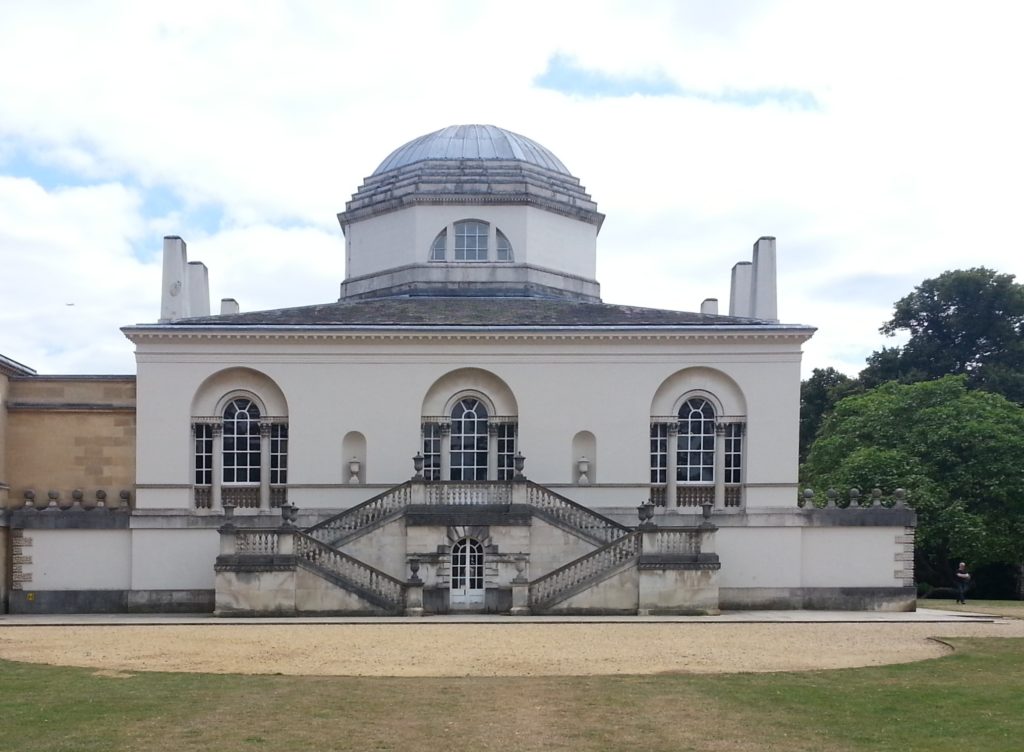
chiswick-house-north-front

Chiswick House- north front

With the design of Chiswick House, Lord Burlington sought to construct and give homage not just to Andrea Palladio, whose work he had seen in situ in Venice and the Veneto, but also to antiquity, Palladio’s contemporaries, and his then greatest English adherent, Inigo Jones. Still, Burlington’s work does contain some idiosyncratic touches, including a marked fondness for the tripartite window design popularized in the work of Serlio, and while known variously as a ‘Palladian’ or ‘Venetian’ window, it is most often, in homage to Serlio, called a serliana. With its use on the west front of Chiswick House, a serliana marks the primary decorative element, while the north front uses three, placed within balustrades and relieving arches, to establish a symmetrical rhythm.

Although the serliana would have been unknown in antiquity, there exists a sufficient nod to the likes of Vitruvius in the Pantheon inspired dome above a window design taken from the Baths of Diocletian, and known as either a Diocletian or ‘thermal’ window. The chimney stacks were formed in the manner of obelisks, a Roman trophy taken from an Egypt conquered in antiquity, and re-erected by Sixtus V to mark significant locations and viewpoints in the midst of the thoroughfares of late Renaissance Rome. Clearly, study enhanced with not one but two Grand Tours was not wasted on Lord Burlington.
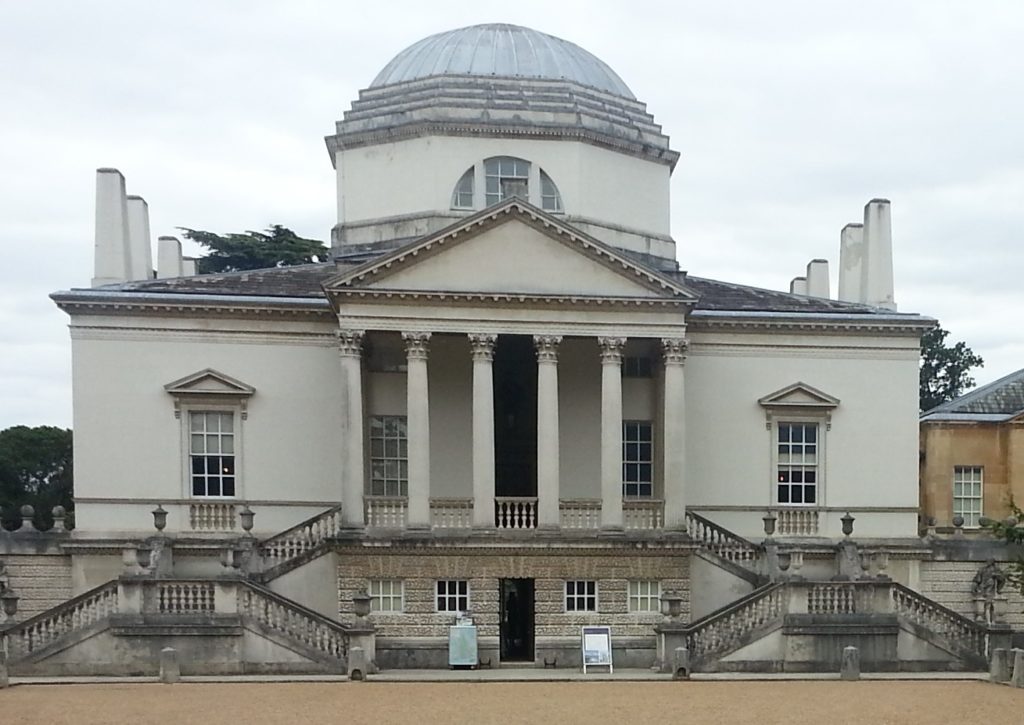
chiswick-house-portico

Corinthian columns in the Chiswick House portico.

While Chiswick House is most commonly assumed to derive from Palladio’s Villa Rotunda, itself derived from the Pantheon, it is hardly a literal quotation and has always seemed to me that, with the greater abundance of ornamentation, Burlington sought to provide more explicit visual references to classical antiquity than did his Venetian predecessor. The columns of the portico are of the Corinthian order, and copied from the Temple of Jupiter Stator in Rome. While a lot has been written over at least the last two millennia about the anthropomorphised personalities and uses of the different orders appropriate to those personalities, it is hard to doubt that Burlington knew everything written up to that time, and used the Corinthian order deliberately. While it has been said that visually the Corinthian was assumed to communicate an air of refinement Serlio had also written it was the appropriate order for churches, particularly those dedicated to the Virgin Mary. It is known that Burlington was a recusant Jacobite, devoted, in his private moments, to the Stuart cause. Perhaps it is not too fanciful to think his use of the Corinthian order is some subtle albeit coded nod to the Stuarts and the Church of Rome.
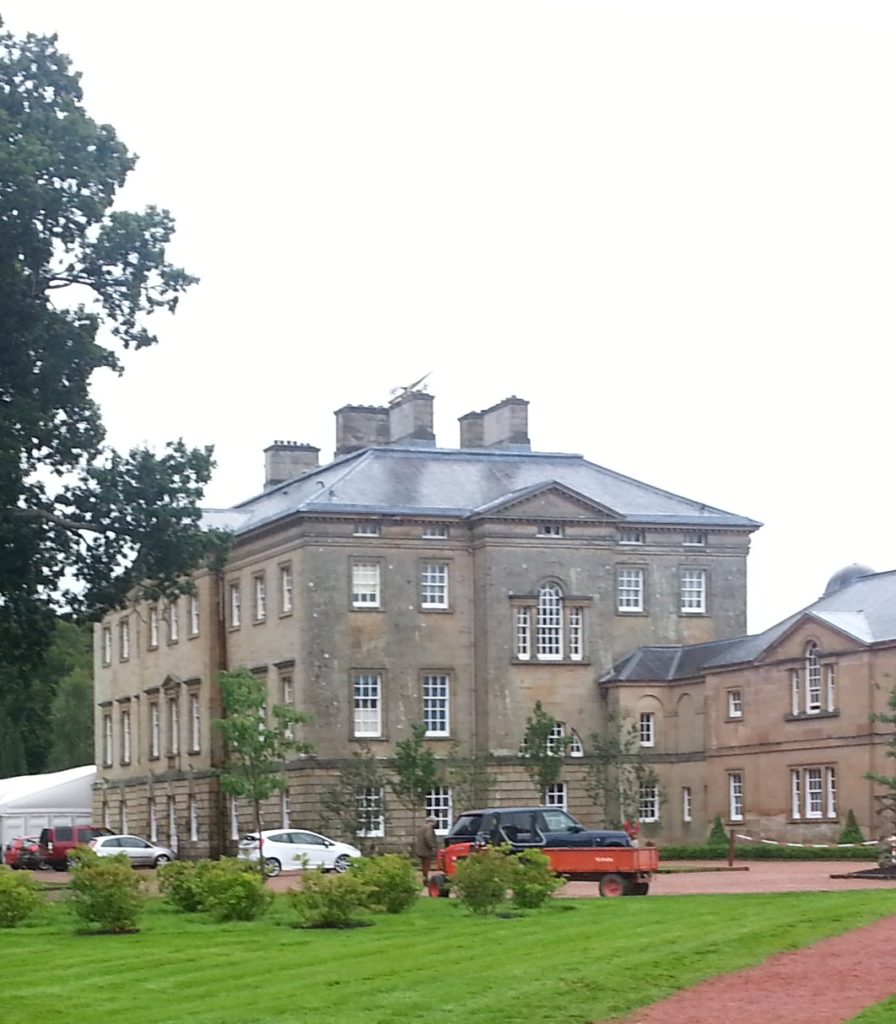
dumfries-house-east-front-detail

Dumfries House, east front, with serliana and thermal window.

Where Lord Burlington handled classical and Renaissance elements to elegant and sophisticated effect, the translation to the seat of a Scottish nobleman was not quite so successful. Simon Green, in his guidebook to Dumfries House, cites correspondence between Lord Dumfries and another Scottish lord, the Earl of Hopetoun, wherein Hopetoun mentions how the Adam brothers had shown some of the drawings for the proposed house to Lord Burlington who, it seems, gave his approval. No question, in the second quarter of the 18th century, Burlington was one of the premier arbiters of taste and refinement amongst the aristocracy, and Chiswick House naturally functioned as a real manifestation of that taste and refinement.
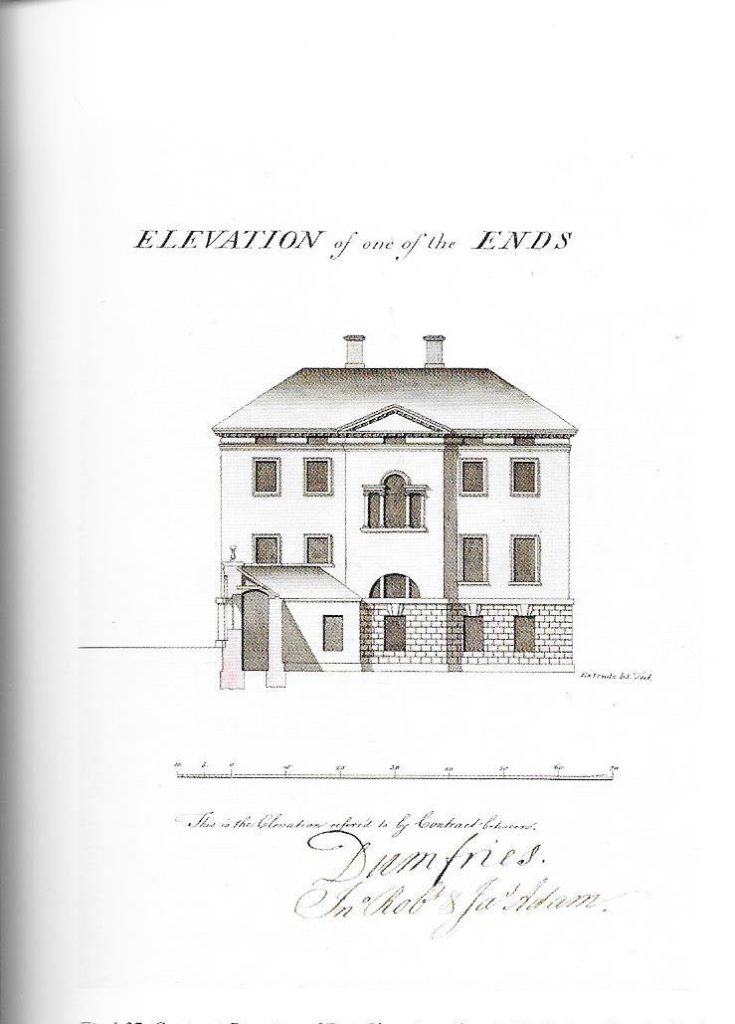
dumfries-house-east-front-elevation

Elevation of the Ends of Dumfries House, signed by the Adam Brothers and Lord Dumfries.

However, in the inexperienced hands of the Adam brothers, the result is substantially less refined. In a view of the east end of Dumfries House, one sees a serliana  used to light the main staircase, and a thermal window placed beneath it to light a passage for the floor below. While the elements are recognizable, their placement and effect are visually dissonant. The arch of the thermal seems flat and heavy with its too close placement below the serliana and directly above the rustication of the ground floor creating thereby a discordant effect. Moreover, the use of both these elements, placed in a central, projecting bay, emphasizes this clumsiness made even clumsier by a lack of a symmetrical and stylistic relationship between the windows of the two bays on either side. The more careful and appropriate scale, placement and rhythm Burlington achieved with a serliana and a thermal was a subtlety that was perhaps beyond the ken of John, Robert and James Adam. Lord Dumfries was no more enlightened, and was doubtless of the belief that use of classical elements, no matter how ineptly wrought, would nevertheless signal his sophistication in matters of design. In this, architect and patron were alike, witness that all of them signed off on the elevation which drawing in itself is of discordant effect. Could something of this sort, as correspondence between Dumfries and Hopetoun implies, been shown to and received the approbation of Lord Burlington? Surprising if it were.
p1010333-crp-dist-dk-s1w760s0-1-q50

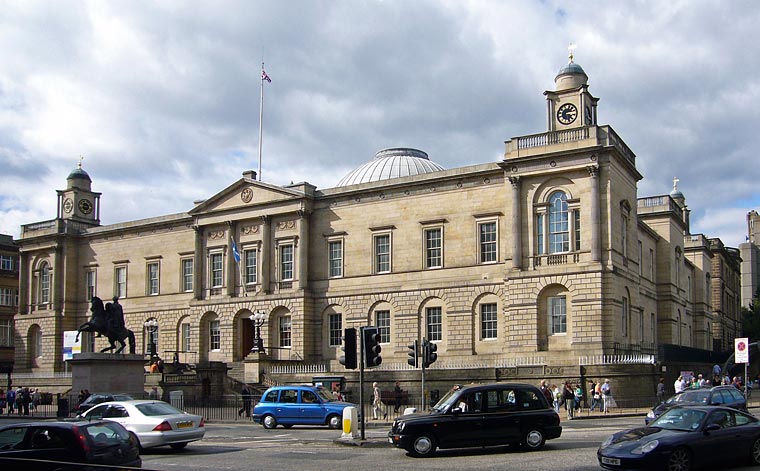
Register House, the serliana well placed.

With all that, Dumfries House and the work of the Adam brothers are significant in that they mark what was the first Scottish residence to display these elements, and also in that it is yet more proof, if any were needed, of the overarching influence of Lord Burlington in matters of design that pervaded Great Britain, even if that influence may not have been shall we say favorably executed. Something to note, perhaps gratuitously, the Adam brothers, and most notably Robert Adam, ultimately became the deserved torch bearers for classicism, with Robert Adam the virtual inventor of a neo-classicism espoused visually to extraordinary effect. Performing something of the role as apologist for Robert Adam, Simon Green does acknowledge the facility and effect with which the mature Adam employed the serliana, citing the Register House in Edinburgh.

For reference, the following are both accessible and worthwhile:

Simon Green, Dumfries House, 2014- the official guide to Dumfries House, with excellent, new scholarship derived from archival sources

Chiswick House, English Heritage. The edition written by Richard Hewlings or the edition updated by Roger White, are complete and succinct. Both Hewlings and White are redoubtable architectural historians closely connected to The Georgian Group, the licensed consultancy in England on the built environment between 1714 and 1837.


It is sad to read about the vicissitudes of the Keno Brothers, characterized by a friend and ‘Antiques Roadshow’ stalwart as ‘the rockstars of the series.’ No question, that they are twins, relatively young, not precisely handsome but certainly distinctive in appearance, and, as the New York Times article detailing their problems has it, ‘telegenic’, they have over the years functioned to bring an interest in and attention to a trade that has been suffering for the lack of it. They are possessed of an intensely energetic delivery that while engaging, is at times so much of a muchness that it makes one wonder whether they have had too much coffee, or having had too much must needs make haste for the gent’s.

Still, what’s been said about them in the press is at the very least bad news for a trade that is often seen to operate in an environment of shadow and prolixity akin to the arcana that is the stock in trade of many of its dealers. The two have debts from unpaid auction invoices in the high six figures, and worse yet, it appears they colluded to run up the hammer prices on a number of the pieces knocked down to them. In the latter, they claim they had miscommunicated, that one brother was bidding online while the other was bidding by phone, and that neither was aware of the actions of the other. Really? Pull the other one- it has bells on it. In the former case, the unpaid invoices result from cash flow difficulties, with the clients who had commissioned the brothers to make these purchases on their behalf then reneging. With the prices for these pieces ostensibly run up by them, I shouldn’t wonder.

While this sort of high profile shenanigan does no good for an industry already on the hardest of hard times, I must say that this is hardly the first I’ve ever heard of shall we say missteps amongst old lags on the Roadshow. Witness, for instance, the fairly recent case of one of the valuers who waxed eloquently about a piece of crockery he thought was a treasure of mid 19th century Americana. Egg on the face quickly followed, when it was discovered soon thereafter the piece was a high school art project of such recent vintage that it was hardly dry.

For those of you who are regular watchers, you might be surprised to find that, with locations changing each week, and nearly all of the faces familiar from week to week, the experts pay all their own expenses- travel, lodging, eats- and are compensated at a rate of zero by the producers of the series. For those experts employed by an auction house- and this constitutes probably half or perhaps more- an appearance can engender interest and result in perhaps a consignment, and presumably this is part of the motivation for some of the private dealers, as well. For myself, this kind of public involvement has not much appeal, as we already get plenty of calls, asking for valuations of items gratis, and offers to sell us something that is totally unlike anything we would ever have in inventory and or could ever sell.

allankatzEven across fields of collecting, the trade in art and antiques is a small fraternity, so inevitably, our paths would have crossed, sometimes almost daily, with a number of those on TV. A few, like Allan Katz, are possessed of the highest degree of knowledge and probity. Whatever Allan says, one could take to the bank. We do, though, know some others who  are sadly greater in number with whom we have had, shall we say, a less than savory experience. A particular paintings expert, for example, is someone about whom I have already written, having formerly been our near neighbor. His neighborly and collegial mien manifested itself by badmouthing a painting we had for sale, expressing the opinion that it was not the real thing when in fact its provenance was clearly documented and contained within the artist’s catalogue raisonné.


I am not a communist. As I feel I have the right to do as I wish with my property both real and personal  and resent and strenuously resist anyone else telling me otherwise, I yet know that my rights end where someone else’s begin.

pimlicoSo it is with Pimlico Road. Keith McCullar and I took a walk through the other day, not so much to visit a dealer, but more to visually survey the health of the trade, with Pimlico Road, in London at least, one of the few remaining venues. Keith and I know of the general predations of landlords, and in particular, the proposed development by the Grosvenor Estate of the 19th century timber yard bang in the center of this venue. A cause célèbre, the proposed development has resulted in a fair old bit of publicity in opposition, including an online petition to present to Westminster Council.

Should I say, though, it is, if there can be such a thing, a minor cause célèbre, as the petition has been online for months, and still has  little more than a thousand signatures- not enough to allow its official presentation and review by the local authority- and the press has been mostly in trade publications. Important, yes- but only paramount to those of us whose nostalgic image is of a once thriving trade, and are in a state of angst as we witness that trade in the manner we’ve always known it sink beneath the waves.

With all that, I must say that the most prominent storefront feature along the Pimlico Road is the green graphic film that covers the windows of nearly 25% of the shop fronts, advertising their availability to let- through, of course, the Grosvenor Estate. It occurred to me that, despite the fear on the part of the remaining dealers, with the preponderance of vacancies witnessing a presumed limited demand of new, prospective tenants, development might reasonably be postponed assuming some trepidation on the part of the Grosvenor Estate about offering yet more space available to rent.

Nostalgic for the way the trade was, yes, all of us are. But I must say that, with the plethora of vacant storefronts, I was driven to opine to Keith that we might consider taking space. He looked at me with a mixture of horror and astonishment and nearly yelled the rhetorical query ‘Are you f—ing nuts?’ He was, I need hardly remind anyone, a reluctant shopkeeper for nearly 15 years, and, regaining my sanity a moment later, I have to admit, our virtual as opposed to our actual storefront is not only much more remunerative, but overall, without the daily obligation of unlocking the door and turning the lights on, something akin to having a millstone removed from around one’s neck.

I suppose going back to the point of beginning this blog, while it is, in general, the right of the Grosvenor Estate to do as it will, it is a sodden thought to consider that in accomplishing its yield objectives, yet more of the London trade, and indeed a significant portion of the remaining trade internationally, would be swept away. Am I nostalgic? Well, given that I am nearer the end than the beginning, of course I am. But I am also mindful of the fact that, with the predations I have seen in my lifetime, I can say that, certainly in terms of the built environment, once something is gone, it is gone for good- or, in the case of the Pimlico Road, for ill.


We’ve today received the umpteenth invitation to ‘join’ some kind of online shopping platform, placing our stock amongst virtual storefronts of what are claimed to be similar dealers, likewise offering their inventory. Our experience with the online platforms, for those of you interested, range in the main from the execrable to the marginal, with some nakedly offering looks- like- but- isn’t material that is well-worn, but not really old.

Over the course of the last five years or so, I’ve lost count of the number of similar invitations, but for right now, we average nearly one a week. So if using this is some kind of benchmark, something in the region of 50 sites of this type are now being launched annually, to say nothing of those already in existence. Mind you, these sites are likewise dropping like flies, but as with these metaphoric flies, they seem for the moment a perennial, perhaps overarching, fixture on the decorative arts scene.

Bear all this in mind when one likewise considers the fate of venerable repositories of honest to goodness period material and artwork, and the places wherein one might acquire same. The venues traditional to traditional material- San Francisco’s Jackson Square, London’s Fulham, Portobello, and Pimlico Roads, and Paris’s Quai Voltaire, to name just the number my gentle reader would be willing to read without the glazing of the eyes- have nearly disappeared. The auction houses are under threat, too, shedding staff, reducing locations, with even venerable Sotheby’s, hard pressed, offering their New York headquarters for sale.

But what of all this? One can come to a simplistic conclusion, that it is expensive to maintain bricks and mortar and cheaper by far to develop and offer fine and decorative arts online. And to form a basis of comparison, separating, as it were, the valuable wheat from the worthless chaff? Nearly impossible online- where quality material is offered cheek by jowl with vintage material, the differences between the two tend to become muddled for the occasional shopper, and discrimination becomes primarily price driven. Unfortunately, for the novice collector and the interior designer working within a budget, price sells. Value for money? Well, no… what can one expect when, shopping price alone, one ends up with what is basically used furniture?

Unfortunately, all of this then becomes a firestorm, with good quality period material and those who sell it dumbing down their inventory if they can, or attempting valiantly to offer it online on one of dozens of platforms, and hoping, too often vainly, that the merits of what it is that’s on offer can be sussed out in preference to what is just cheap. And the cheap gets featured in the design editorials that are an integral part of most of these websites, which then piques an interest in and breeds a demand for more cheap pieces.

And the firestorm intensifies. The venues and their traditional population get fewer and fewer by the day, and the decorative arts platforms proliferate only to burn hot until investor money runs out, and the buyer ends up with cheap cack. I suppose everyone needs something to hold in abeyance for the next yard sale.

Interestingly, I read yesterday in one of the trade publications of a young man who just opened up a shop in London, near to Lots Road. In these times, the opening is noteworthy in itself, but sadly, his storefront replaces that of a dealer who had just bitten the dust. Still, he claims his shop is opening in response to a demand for quality pieces by millenials who are reacting from what he terms ‘the throwaway mentality’ with the actual storefront, in preference to the virtual, a venue for browsing, interface, and the development of connoisseurship.  Good on him, and hope that this is a harbinger of change from on the cheap to a welling, long lived- and long overdue- demand for lasting value.


We’ve embarked on our Summer Sale, something that I annually look forward to, and not just for the influx of a bit of the ready at a time of year when our cash flow is at a low ebb. Well, maybe the money is the thing I most look forward to, but the increased contact with people who visit us primarily during sale time is a good thing, too, as are the concomitant comments.

I’ll try to leave the alliteration alone, but suffice to say something we’ve heard annually for as long as we’ve had our Summer Sale is the sorrow at the decreased level of interest in decorating with period furniture, in preference for other styles. And we’ve for just as long had the same rejoinder, that with the preference for internet shopping, anyone with money to spend is spoiled for choice. Not just period material, but things as far afield as the vague looks-like- but- far- from -is offerings proffered by Pottery Barn and Wayfair.

But the fact is, in our efforts to market we may be functioning to extend these condolence comments in the use of period vignettes, trying as we do to give some sort of context to the items we offer. As we will often have as many as ten different pieces- one or two large furniture items, ‘fluffed’ with say 7 or 8 decorative items- it does perforce give some kind of overdone, Victorianized feel to what it is we sell. Our alternative, and one we try to integrate into our marketing efforts from time to time, is featuring a single item, but I have to say we do this judiciously, as the result can often times seem very stark and sterile.

Beyond just saying so, it is difficult to communicate to prospective buyers that in fact most of our material goes to homes that will utilize just one, or maybe at most a handful of period pieces integrated into what is easily recognizable as a contemporary interior. There are likewise a handful of interior designers that can successfully pull this off, but rather than naming names and risk offending those I did not name, I would suggest picking up World of Interiors, the Conde Nast shelter magazine published in England that has habitually done a masterful job of using period and contemporary materials in its editorial and ad features.

For us, though, with a limited access to Philip Johnson or le Corbusier designed homes in which we can deploy and photograph for promotional purposes our stock in trade, we’ve attempted over the last few months to stay abreast of social media, and more importantly, to provide a virtual Johnson -Corbusier matrix through the design of our own website. Will this ameliorate the inadvertent effect of vignettes? Time will tell of course, but of whatever stripe or context, we welcome all comments, even those unaccompanied by cash.