
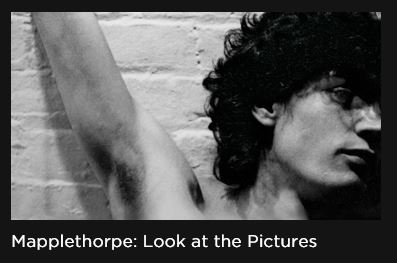
MapplethorpeStill not so old and not so jaded- no chortling from the back of the house- but where I find Jesse Helms’ tirade about the work of Robert Mapplethorpe an anachronism from the benighted days of the Moral Majority, Mapplethorpe’s work itself is as freshly, vivaciously intense now as it was- my goodness- 40 years ago. Astonishing, isn’t it?, how and what achieves canonical status, while its criticism becomes period buffoonery.

Initially, my enjoyment of the new documentary ‘Mapplethorpe: Just look at the pictures’ was as it served primarily a nostalgic walk down my own memory lane. Too many paid the price for the gay hedonism of the ‘70’s and early ‘80’s, but no one who’s honest would say it wasn’t fun, and it was. Senator Helms castigation of Mapplethorpe’s work, with his ‘Just look at the pictures!’ on the floor of the US senate a ranting, prima facie indictment of the photographs beyond which, he reasonably assumed, no further discussion was necessary, indicates his place in a terrifyingly marginal world much more limited, ironically, in its outlook and experience than the one he sought to demonize.

The fact is, gay sex was then, in the early years of liberation, overwhelming celebratory, and I just don’t see any of the Mapplethorpe images, whether erotic or not, anything less than ecstatic. And if that ecstasy and celebration spilled over into what one might euphemistically term some of the byways of sexual expression why, after centuries of repression, would one expect anything else?

Keith and I had a vague connection with Mapplethorpe, and indeed yet maintain a friendship on social media with mutual acquaintance ‘That Boy’ Peter Berlin, himself interviewed for the documentary. Both though, were successful in their lifetimes as flagrant self promoters, but pulchritude wanes, and Peter has seen a revolution of the clock hands- as have I- a very many times. This sounds as though I am implying that Mapplethorpe’s images are, with his death in1989, trapped in time, representative only of the era in which they were taken, and, frankly, that’s not the case. Mapplethorpe wasn’t a tremendous photographic technician. Indeed, he required a substantial amount of assistance in the darkroom and processing to yield the types of images his best work represents. But with all that, he was a master at framing a picture and selecting subject matter, with his work, even his still lives, maintaining an energy that lifts the images out of any time.  We know that, because we can still take Senator Helms’ cue- ‘Just look at the pictures!’ Old and jaded I may be- ‘may be’ I said- but looking at Mapplethorpe’s work yet remains a pure pleasure.

‘Mapplethorpe-“Just look at the pictures!”’ on HBO Documentaries

‘Robert Mapplethorpe: The Perfect Medium’ at the Getty Center, through July 31, 2016


TEFAF Maastricht has come and gone, and not yielding much more than a ripple, apparently, in the world’s art market. Mind you, all this occurred with a too close for comfort backdrop consisting of the terrorist activity in Brussels- a transit point for many attendees. A profound tragedy, its terrible effects doubtless also impacting all manner of business, certainly including the art and antiques trade.

Concomitant with Maastricht, though, is the release that’s become now an annual tradition, the art market report prepared by Dr. Clare McAndrew. About the only thing of its kind detailing trends in the international trade in art and antiques, I have always been a skeptic of the report as its commission by the body that governs Maastricht seemed, in its questions and format, skewed toward a confirmation of the necessity of art fairs- particularly Maastricht- and their overall success for those who participate in them. Well, I suppose everyone has a living to make, and Dr. McAndrew, as the saying goes, must dance with the one who brought her.

Still, the difficulties that everyone in the trade has faced over the last year, and indeed is still facing and will face for the foreseeable future, and the reasons for them are no surprise, and indeed borne out by the art market report. China’s present economic travails have had a devastating effect on the global trade, with an enormous contraction of sales to the formerly burgeoning Chinese market. The knock-on effect of the slowing Chinese economy, though, has wrought an overall impact on the global economy, now teetering on, if not already entered into, recession.

All this has moved everything, including contemporary art, very much off the boil.  More than any other industry, the art and antiques trade depends on the perception of wealth. Are the wealthy now unable to afford what is for all intents and purposes the luxury goods, the subset of which is the entirety of the stock in trade of all galleries, auction houses and private dealers? Well, frankly, no. But then, I have never, ever seen anyone who has traded with us encash an investment to make a purchase- everything is dependent on ready cash. Moreover, that ready cash is kept at the ready when the punter is feeling flush.  While one may debate the extent of the global economic slowdown, we can all agree that it is suffering a case of the jitters. Under that circumstance, the ready cash our buyers are willing to part with feels, unfortunately, more comfortable for the time being remaining in the buyers’ wallets than it does invested in what it is we have to sell.

Addendum: Cheyenne Westphal, Sotheby’s worldwide head of contemporary art, announced her departure after 25 years with the auction house as part of the company’s ongoing staff reductions in an effort to shore up its bottom line. Read more at Bloomberg Business.


Leon Lock is one of the most intelligent and urbane men of my acquaintance- a gentleman in every sense of the word, whose friendship I’ve had for nearly 20 years Low countriessince the time we were doctoral students in the department of the history of art at University College London. Since 2002, Dr Lock has been the director of the Low Countries Sculpture Society in Brussels, itself an expression of the sophistication and civility that marks arguably the most civilized region of our troubled planet.

It is contrasted with this that we witness the tragedy that befell Brussels this morning, wrought with an eye toward the commission of a barbarous act that sets the pace of humanity back 1,000 years. With Europe’s open borders an expression of an attempt to overcome ethnic divisions that predate history, this act of terrorism will doubtless work to slow, if not stifle, a model for liberality the entire world should emulate. Indeed, the present ‘Brexit’ debate and those favoring it in the United Kingdom were certainly given impetus by what happened today.

Sadly, it is not only the Boris Johnson’s of the world who seek insularity as the cure for all international ills, but here at home, Donald ‘Torquemada’ Trump is renewing calls for the use of torture to prise secrets from terrorists. And with this, we must all realize, the terrorists have won. While we may seek to foil terrorist plotting, its response by a benighted few may succeed in prising from the rest of us not just our liberties but the better angels of our nature.

In 2005, I was in London’s West End at the time of bombings. Indeed, the bus that blew up was just around the corner from Gordon Square- the heart of University College London. I remember well, with the consequent cessation of public transportation, walking back from Bond Street along Bayswater Road, returning to our flat in Notting Hill. Keith and I shared this walk with thousands of others, and we were struck at the time with the doggedness of it, the determination to literally and figuratively put one foot in front of another, getting on with the business of life.

I pray that Leon Lock is unhurt by today’s terrible events, but likewise pray for those who are not. But I also pray that the better world the best people in the world seek to create is not forever scuttled.

Addendum:

Leon has emailed to say he’s fine, but his office on Trierstraat is only 20 metres,  a mere stone’s throw,  from the bombed Maelbeek metro station.


Dealers push excreta through the fan blades, following 1st dibs draconian changes. Read more in the New York Times:

On Tuesday evening, a sign was placed in the window of Lost City Arts, a high-end vintage design store in Lower Manhattan, saying the shop was closing early. Inside, 30 of the city’s top antiques dealers had gathered for a tense, hastily arranged meeting. Other dealers dialed in from Texas and California to hear the proceedings.

The topic: the online antiques marketplace 1stdibs and its new approach for enforcing commissions.

Jim Elkind, Lost City’s owner, addressed his colleagues, who sat amid the kind of $4,000 Italian floor lamps and $2,800 midcentury modern low tables that are routinely sold (or just ogled) on 1stdibs.

“This sort of reminds you of that moment in ‘The Godfather’ when all the heavyweight bosses from the mafia show up to the big party,” Mr. Elkind said to laughs. “I think we are a formidable group here.”

But as the dealers began to voice their concerns and frustrations, it became clear they view themselves not as powerful figures but as little guys being pushed around and financially squeezed by an influential company they have come to rely on.

Under its new guidelines, which are to take effect April 4, 1stdibs requires that all sales resulting from what it calls a “1stdibs lead,” or interaction generated on the site, be processed through the company, so it can charge a commission of as much as 10 percent. The move effectively closes a loophole whereby dealers could finish a negotiation offline, thus avoiding the fee.

The company will also start monitoring and recording conversations that take place over a message center and dedicated phone number where dealers and buyers interact.

“The idea of them having a recording of all of our phone calls, it feels Orwellian,” said Paul Donzella, owner of Donzella in TriBeCa and a 1stdibs dealer for more than a decade, who attended the meeting. “If I ask the buyer for their phone number, the site’s detectors will pick up those keywords and shut the communication down.”

Some dealers (though not Mr. Donzella) have already experienced such a rebuke from 1stdibs. And they said they are troubled by the way, in their view, 1stdibs is prizing revenue growth over dealer relationships, and increasingly removing the ability for them to work directly with clients or be forthright.

For instance, since 2014, dealers have been forbidden to tell buyers that 1stdibs charges transaction fees or refer to “1stdibs fees of any kind.” Guy Regal of Newel, a decorative arts store on the Upper East Side, told his colleagues at the meeting that it puts dealers in a difficult spot both financially and ethically. 

Other dealers present, including Eric Appel and Dobrinka Salzman, said they would most likely have to raise prices or reduce or eliminate the discounts they routinely give to interior designers and architects. Yet they can’t tell their clients why.

“Do you understand the politics of that?” Mr. Regal said in a phone interview later, explaining that the antiques business is based on relationships. “You don’t spend $60,000 on something without seeing it, talking to the dealer and getting a sense of who they are.”

Indeed, the old-school way of selling rarefied objects face to face is clashing with the culture of a tech company focused on growth. Once an exclusive club for a few hundred tastemakers to sell their curated wares, 1stdibs now has more than 2,000 dealers.

For all the complaints about 1stdibs and talk among the dealers about staging a walkout, many acknowledged its crucial importance to their business, as well as the site’s ability to expose their goods to a global clientele.

Founded in 2001, 1stdibs basically pushed the antiques business into the 21st century, allowing dealers to rely less on costly brick-and-mortar stores and reduce the amount of time and money they spend on marketing. In recent years, the company has aggressively ramped up its staff and marketing in its ambition to become a major global brand such as Christie’s or Sotheby’s.

David Rosenblatt, the chief executive of 1stdibs, defended the new policy as necessary for the company’s continued growth, saying that when he was hired five years ago, the site began transitioning from a place for dealers to advertise their goods to an e-commerce platform. The improved site, he said, has resulted in favorably negotiated deals with shippers, programs like fraud protection for dealers and online sales of $150 million so far.

“Like any company, we need to see a return on our marketing investment,” Mr. Rosenblatt said, explaining the reason for the dealer commission, which was introduced three years ago but difficult to enforce. (The site also generally charges dealers a fixed monthly fee and per-item listing fees that are credited back to them if the item sells through 1stdibs.)

Mr. Rosenblatt added that the new monitoring system was needed to prevent dealers from steering buyers offline to avoid paying a commission. Those dealers, he said, “reduce our ability to market on their behalf. We wake up every morning thinking about how to grow their business.”

While some dealers feel the fees are excessive (“They’re triple- and quadruple-dipping,” one exasperated dealer said at the Lost City meeting), others say the potential for profit and prestige is worth the cost.

“If you are providing me with a top-notch clientele all over the world, I am not going to be questioning the fees,” said Jimmy Lam, owner of Antique Textiles Galleries in Fort Lauderdale, Fla. “I am selling double or triple what I was selling three years ago,” before joining 1stdibs.

Mr. Rosenblatt said the customers will ultimately decide — and they are choosing to shop online. “If the dealers are not comfortable,” he said, “they have the ability to move their business elsewhere.”


Nancy_Reagan_Red_Room_1981

One of the delights of participating in the Los Angeles Antiques Show, now, sadly, of blessed memory, was the one- never- knew experience of the entertainment celebrities one might have even brief face time with. Particularly when the ladies guild of Cedars Sinai Hospital was the benefit charity, the gala preview was a welter of attendees of the great and good. A simple country lad me, I put my foot in it more than once, asking an unrecognized Harvey Weinstein, for instance, what he did for a living. His tongue in cheek response was ‘I own a small production company.’

An occasional attendee was the very petite presence of Nancy Reagan, who darkened the precincts of our stand in 2005 and 2006. Small and well dressed, and with a discreet security detail, she did on a couple of occasions ask questions of us about a couple of items, and then moved on. Both times, after the fact, Keith and I queried one another why it was we didn’t ask her the why of the tragically laggard response the White House had to the AIDS crisis. No question, with her own experience in the entertainment community, including, amongst others, her close and decades-long relationship with openly gay designer William Haines, her husband and she certainly had a level of familiarity with the gay community that, years before the death of Rock Hudson in 1985, they and particularly she certainly knew what was happening.

Time goes on, however, and I am ashamed to admit it, our own commercial imperative prevailed- we were, after all, at the Los Angeles Antiques Show in order to earn our daily crust- so beyond talking amongst ourselves, and one or two others, nothing of significance came of the Nancy sitings beyond being able to include these episodes as anecdotes.

However, early in 2008, Mrs. Reagan came tangentially- but significantly- into our ambit when we sold a William and Mary cabinet on stand to a Los Angeles celebrity, whose home our celebrity client had acquired from celeb cum media mogul Merv Griffin, by then deceased. We knew Merv was gay as pink ink, with an ex- wife and another female celeb- Eva Gabor- who for years ‘bearded’ for him, and also that he was on such close terms with the Reagans he was an honorary pall bearer at Ronald Reagan’s funeral.

It was a wonderful house, with a tennis and swimming pool pavilion that rivaled the size and elegance of a fine home. However, one of the striking things about the lovely landscaping was a large rose garden. Our celebrity client told us that it had been laid out and the roses selected for Merv by Nancy Reagan. Keith and I were particularly struck by this, bringing to the fore yet again a perplexity of why, with this level of intimacy and a level of intimacy she shared with so many other gay men, Nancy Reagan, and of course her husband, did so little and did so late even acknowledge the AIDS epidemic.

I suppose Nancy Reagan’s silence mirrored the traditional silence in Hollywood about gay men in the entertainment industry, which silence yet remains overarching. I suppose. But it was a silence that as ACT-UP has it, did then and does now equal death. Precisely how Mrs. Reagan was able to overlook this tragedy which she must have seen from a front row seat is impossible to know, and difficult to forgive.

It is now, however, a question for the ages.